
Dutasteride vs Finasteride: Is Dutasteride Really Better?

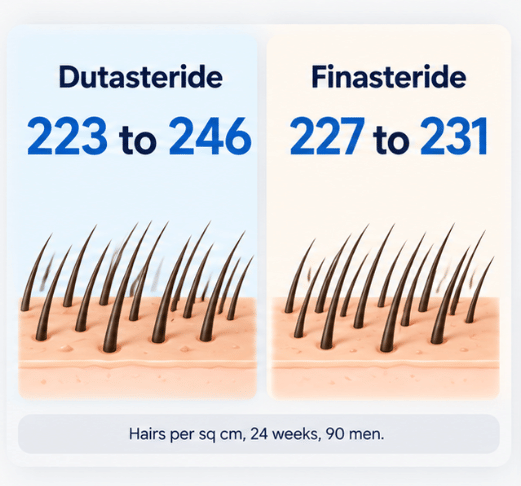
Dutasteride lowered DHT more than finasteride and grew more hair in head-to-head trials of up to 24 weeks. In a 2017 Mumbai trial of 90 men, hair count rose by 23 hairs per square cm on dutasteride 0.5 mg. It rose by 4 on finasteride 1 mg. Side effects were similar in both groups. That does not make dutasteride the right first drug for everyone. Both are prescription medicines, and long-term head-to-head data are still missing. A dermatologist should confirm the cause of hair loss first.
How Do Dutasteride and Finasteride Lower DHT?
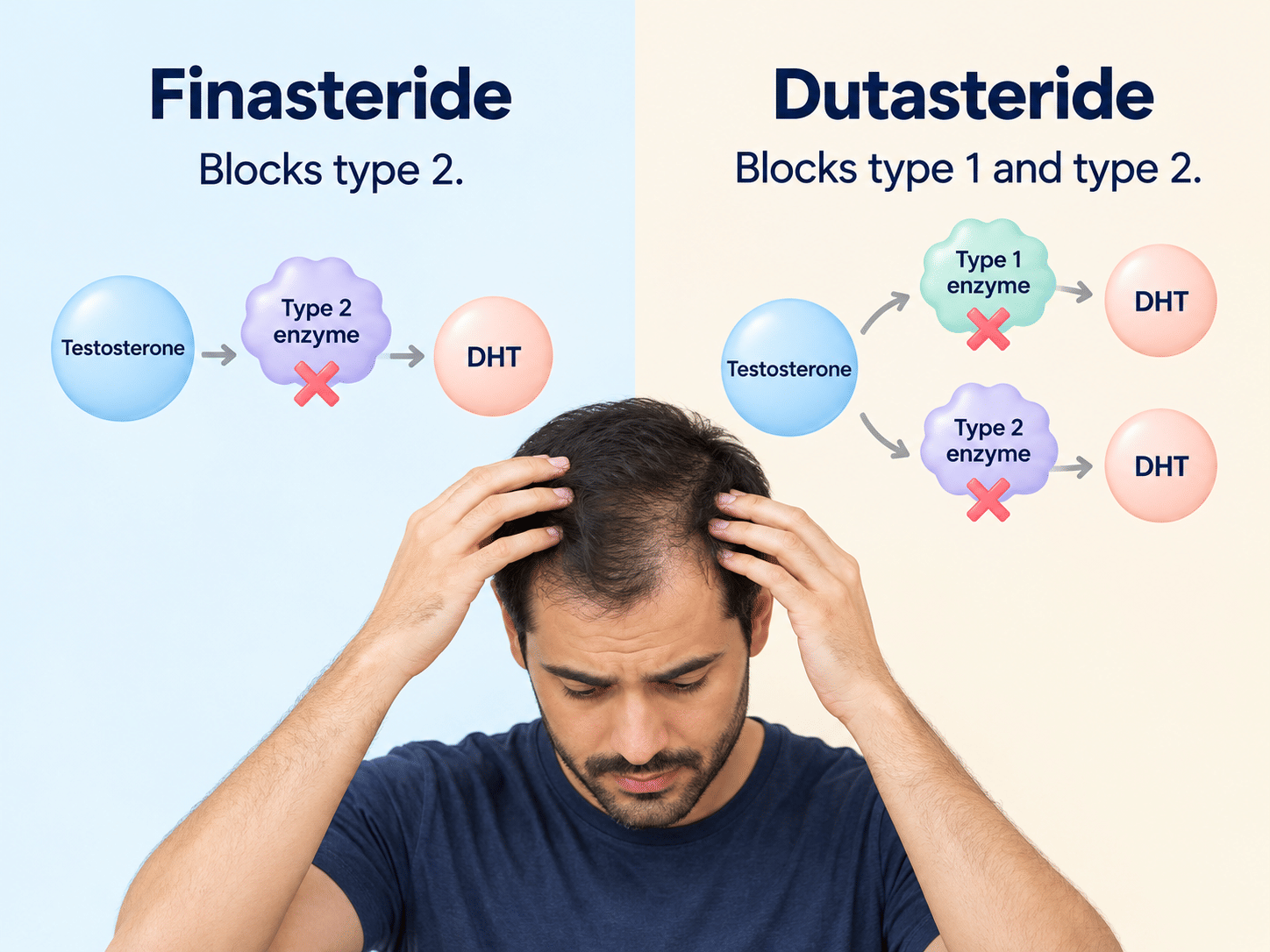
Both drugs block 5-alpha reductase. This enzyme turns testosterone into DHT, the hormone that shrinks hair follicles in male pattern hair loss.
The enzyme comes in two forms, type 1 and type 2. Both are found in hair follicles. Finasteride blocks only type 2. Dutasteride blocks both.
That difference shows up in blood tests. In a 24-week trial of 399 men¹, published in 2004, dutasteride 0.5 mg cut blood DHT by about 95%. Finasteride 5 mg cut it by about 71%. Those men had an enlarged prostate, and the finasteride dose was five times the 1 mg used for hair.
These rows come from MedlinePlus, the US dutasteride label on DailyMed and the IADVL finasteride guideline.
Many men also read frightening stories online about finasteride’s sexual side effects. That worry is real, but those stories often exaggerate the risk or mix up doses, so a doctor should explain the real picture and set the right dose for you.
What Do the Head-to-Head Trials Show?
Head-to-head trials found more hair growth with dutasteride than with finasteride at 24 weeks. The evidence comes from India and from large global trials.
The Indian trial
A 2017 trial in the Indian Journal of Dermatology, Venereology and Leprology² tested both drugs at a Mumbai public hospital. It enrolled 90 men aged 18 to 40 with male pattern hair loss. Each man took dutasteride 0.5 mg or finasteride 1 mg every day for 24 weeks.
The results, measured in a fixed patch of scalp:
- On dutasteride, total hair count rose from 223 to 246 hairs per square cm.
- On finasteride, total hair count rose from 227 to 231 hairs per square cm.
- Thin, shrunken hairs fell more on dutasteride, a sign that follicles were recovering.
The study was short, and both doctors and patients knew which drug was given.
The larger global trials
A 2014 trial of 917 men aged 20 to 50³ ran across several countries. Dutasteride 0.5 mg grew more hair than finasteride 1 mg at 24 weeks. Side effects were similar across the groups.
A 2019 review pooled three trials with 576 men⁴. On average, dutasteride added about 28 more hairs in the counted area than finasteride.
None of these trials ran longer than six months, so long-term comparisons are still missing.
Can You Get Dutasteride for Hair Loss in India?
Yes, but only on a doctor's prescription. Dutasteride is a prescription medicine, and its use for hair loss should be decided by a dermatologist.
The US label on DailyMed lists only an enlarged prostate (BPH). So in the US, using it for hair loss is off-label.
Never start either drug on your own. A doctor needs to confirm the cause of hair fall first.
Do Side Effects Differ Between the Two?
Side-effect rates looked similar for both drugs in hair-loss trials. A 2019 review of 15 trials⁵ found a small rise in sexual side effects with finasteride. The rise with dutasteride was smaller and not statistically clear.
In the Mumbai trial, both groups had the same side effect profile. Lower libido and erection problems were the most common, and they resolved in that trial. One short study cannot show how often that holds for everyone.
Many men worry about sexual side effects before they start, often because of stories online. Most of these stories are not based on trials. India's dermatology body, the IADVL, says the reported sexual side effects are few and usually reverse when the drug is stopped. It asks doctors to explain these risks before treatment starts. A dermatologist can set the right dose and talk through any worry. For a wider safety view, read which DHT blocker actually works.
Who Might Switch From Finasteride to Dutasteride?
Men who see too little change after a fair trial of finasteride are the usual candidates. Our guide on whether finasteride regrows hair sets out that timeline.
Many men wait too long before they ask. In Man Matters consultation data from 7,04,152 men (Aug 2025 to Aug 2026), 2 in 3 were already at Norwood Stage 3 or higher at their first consult.

A dermatologist will weigh a few things before any switch:
- Your stage of hair loss and how fast it is moving.
- How you did on finasteride, including any side effects.
- Your plans for a family in the coming months.
- Other medicines you take.
The long half-life matters too. The US dutasteride label says men should not donate blood until 6 months after the last dose. It also says women who are or may be pregnant should not handle the capsules.
Can You Use Either Drug With Minoxidil?
Yes, doctors often pair a DHT blocker with minoxidil. Minoxidil helps follicles stay in the growth phase and does not lower DHT. A DHT blocker slows the shrinking that DHT causes.
One option is a mix applied to the scalp. A 2025 randomised trial in 40 men⁶ tested 5% minoxidil with 0.1% finasteride. Hair density and hair thickness rose over 12 weeks. Side effects were similar to minoxidil alone. To compare the two approaches, read minoxidil vs minoxidil with finasteride.
Man Matters' Minoxifin (5% Minoxidil + 0.1% Finasteride) uses this same combination. Alcohol and propylene glycol are the main irritants in standard minoxidil solutions, a 2014 formulation study⁷ found. Minoxifin has an alcohol-free formulation which reduces the chances of side-effects like scalp irritation and redness, commonly associated with minoxidil. If you face any issues, speak to a doctor. Use it twice daily, and give it five to six months.
How Should You Choose Between Them?
Start with a diagnosis, not a drug. On the Man Matters app, you can talk to a dermatologist. They check your family history, lifestyle, diet, sleep and a photo of your hairline. Then they find the root cause and confirm your stage. Only then do they set the right treatment.
When you buy minoxidil or finasteride from Man Matters, you get a free pass to talk to a dermatologist.
Hair loss is common, and feeling unsure about the next step is normal. The men who see lasting change treat hair care as a routine, not a one-time fix. They follow a plan built for their diagnosis, keep up the basics, and stay with it for months.
Frequently Asked Questions
Is dutasteride really better than finasteride?
In head-to-head trials, dutasteride 0.5 mg grew more hair than finasteride 1 mg over 24 weeks. A 2019 review of 576 men found about 28 more hairs in the counted area. That does not make it the right first drug for everyone. A dermatologist decides which drug to try first.
Can dutasteride regrow lost hair?
Dutasteride can regrow some hair in men with male pattern hair loss. In a Mumbai trial of 90 men, hair count rose from 223 to 246 per square cm over 24 weeks. Thin hairs also became fewer. Results need daily use and a doctor's supervision.
What are the risks of taking dutasteride?
The main reported risks are sexual side effects, such as lower libido or erection problems. In a Mumbai trial of 90 men, these were as common as with finasteride and resolved during that study. Take it only under a doctor's care.
Should I switch from finasteride to dutasteride?
Switch only if a dermatologist advises it. The usual reason is too little change after a fair trial of finasteride. A doctor will check your stage of hair loss, side effects so far and other medicines first. Never change prescription drugs on your own.