
Minoxidil Oral vs Topical: Which Is Right for Your Hair Loss?

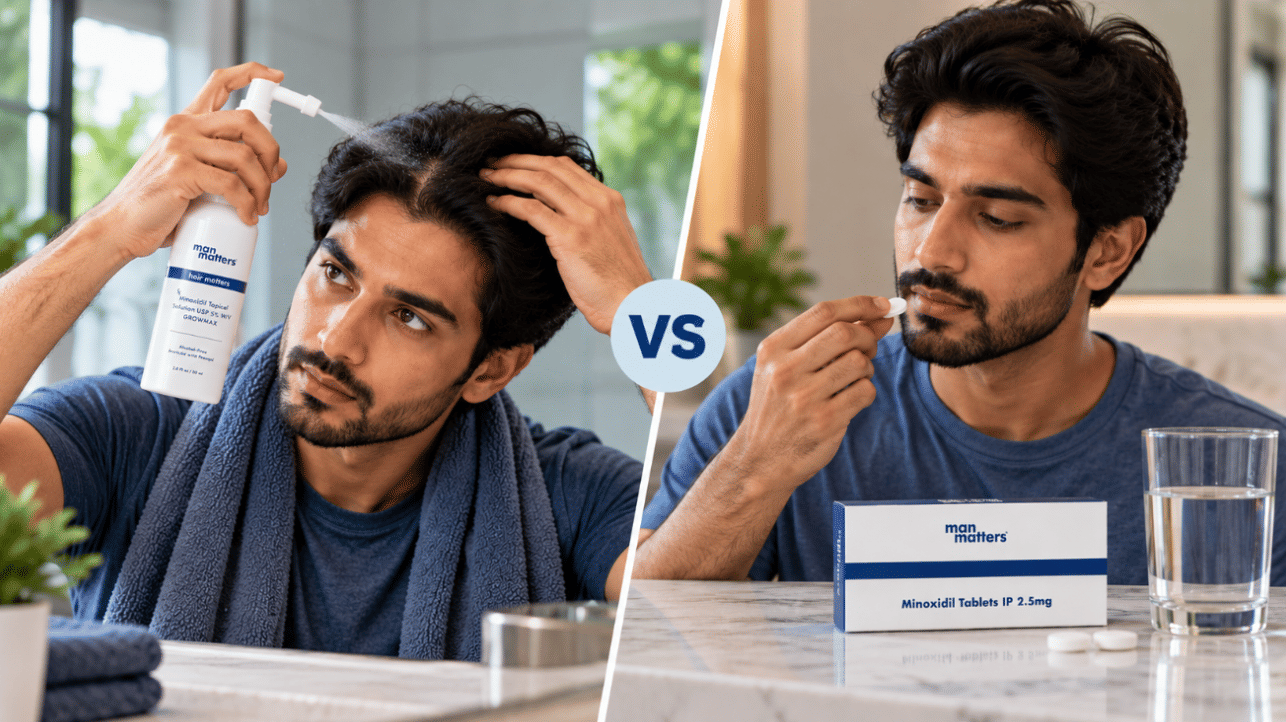
Minoxidil oral vs topical is a matter of one drug taken in two different ways. Topical minoxidil is applied to the scalp. Oral minoxidil is a systemic medication (a pill taken that works throughout the body) and thus has different exposure and safety issues. Oral minoxidil 5 mg however did not have any overall superior to topical minoxidil 5% in a 24-week randomized trial in men. There is no one right path for every man. It is contingent upon your hair loss, your health and a doctor’s evaluation whether it is for you.
What Is the Difference Between Minoxidil Oral vs Topical?
Oral and topical minoxidil are two different ways of administering the same active ingredient - one is taken as a tablet and the other is applied directly to the scalp and this is why their exposure, evidence of effectiveness and safety profile differ.
If you’ve been on hair-loss forums at all you’ve probably seen both sides. Some men swear the tablet made all the difference, because finally they stopped missing applications. Others warn that popping a blood-pressure pill for your hairline is a bridge too far. Both sides are reacting to something that is real, and that's why this comparison is so confusing.
And beneath the debate, there is usually something quieter happening. Hair loss is an odd kind of problem: small enough that no one else seems to notice, big enough that you think about it all the time. And that’s the gap where confidence silently disappears, and many men work through it alone, late at night, in threads they haven’t said a word about to anyone.
It’s okay to feel stuck here. Most men asking this question don’t know what’s causing their hair loss. They come tired of guessing. The useful way through is to distinguish between three things that forum threads tend to blur together:
- How the drug reaches your hair follicles - through the scalp, or through the bloodstream.
- What the head-to-head evidence actually shows - and in whom it was tested.
- What each route asks of you - a twice-daily scalp routine, or a daily tablet with medical oversight.
This guide walks through each one without declaring a winner, because the evidence doesn’t support one. If you would rather not untangle this alone, there is a more structured way in. At Man Matters, the journey starts with a short online hair assessment covering hair fall, scalp condition, family history and lifestyle, which places you on the hair-loss scale. A dermatologist consultation follows, where your family history, diet, sleep, current concerns and a photo of your hairline are reviewed before your stage and treatment plan are confirmed. Follow-ups come after that, so the plan can be adjusted with consistency rather than dropped.
How Do Oral Minoxidil and Topical Minoxidil Work?
Oral and topical minoxidil contain the same active ingredient, but the route of delivery alters the amount of drug that reaches systemic circulation and thus alters the exposure and safety considerations.
Minoxidil was first developed as an oral blood pressure medicine. They later saw it worked on hair growth. A thorough review of minoxidil shows that its effect on the hair is due to several mechanisms, including the dilation of small blood vessels surrounding the follicle and the modification of the hair growth cycle. The exact mechanism is not yet fully established.
The big difference is in where the drug goes:
- Topical minoxidil: Minoxidil is applied topically to the scalp, only a small fraction passing through the skin. That same review mentioned above estimates cutaneous absorption at 1.2-1.4%. This is why the systemic exposure from topical use is much lower. Not zero, but low.
- Oral minoxidil: It is taken by mouth and absorbed through the gut into the bloodstream. Then it goes all over the body, not only the scalp. That wider exposure means its safety profile is different.
Here's how it goes. The topical minoxidil is aimed at the target. Oral minoxidil is a systemic therapy and it gets to the target on the way.
You don’t have to know pharmacokinetics by heart to make a good decision. The important thing is to understand that the path does change the trade-offs and that a dermatologist can weigh those trade-offs against your own health history.
What Is the Difference in Effectiveness Between Oral and Topical Minoxidil?
A 24-week double-blind RCT in men with androgenetic alopecia did not demonstrate overall superiority of daily oral minoxidil 5 mg over twice-daily topical minoxidil 5%, although photographic improvement at the vertex was observed more in the oral group.
The trial is Penha et al, published in JAMA Dermatology, 2024. This is the most direct comparison of the two routes that is available. This is what was involved:
- Who: 90 men with androgenetic alopecia (male pattern hair loss) were enrolled in the study and 68 completed the study.
- Where: a single centre in Brazil.
- What: oral minoxidil 5 mg once daily versus topical minoxidil 5% twice daily.
- How long: 24 weeks.
The main result was that oral minoxidil was not overall superior to the topical minoxidil. The only evidence in favor of oral was photographic improvement at the vertex, the top of the head, which was seen more often in the oral group.
That’s a good result, but with obvious limitations. It tested 5 mg oral so it cannot be applied to 2.5 mg or other doses. It lasted 24 weeks, so it can't tell you about long-term results. And at one center it lost 22 of 90 participants in the process. Make it a great place to start, not the end of the line.
The fact is, there is a practical side to effectiveness that trials find difficult to quantify - consistency. In the trial, topical minoxidil was applied twice daily. Real life is more messy. Gym sessions, travel, hair styling and late nights all interfere. You have to actually use a treatment on those days for it to work. If you’re new to using topical minoxidil, our guide on how often to use minoxidil 5% goes into the routine in more detail.
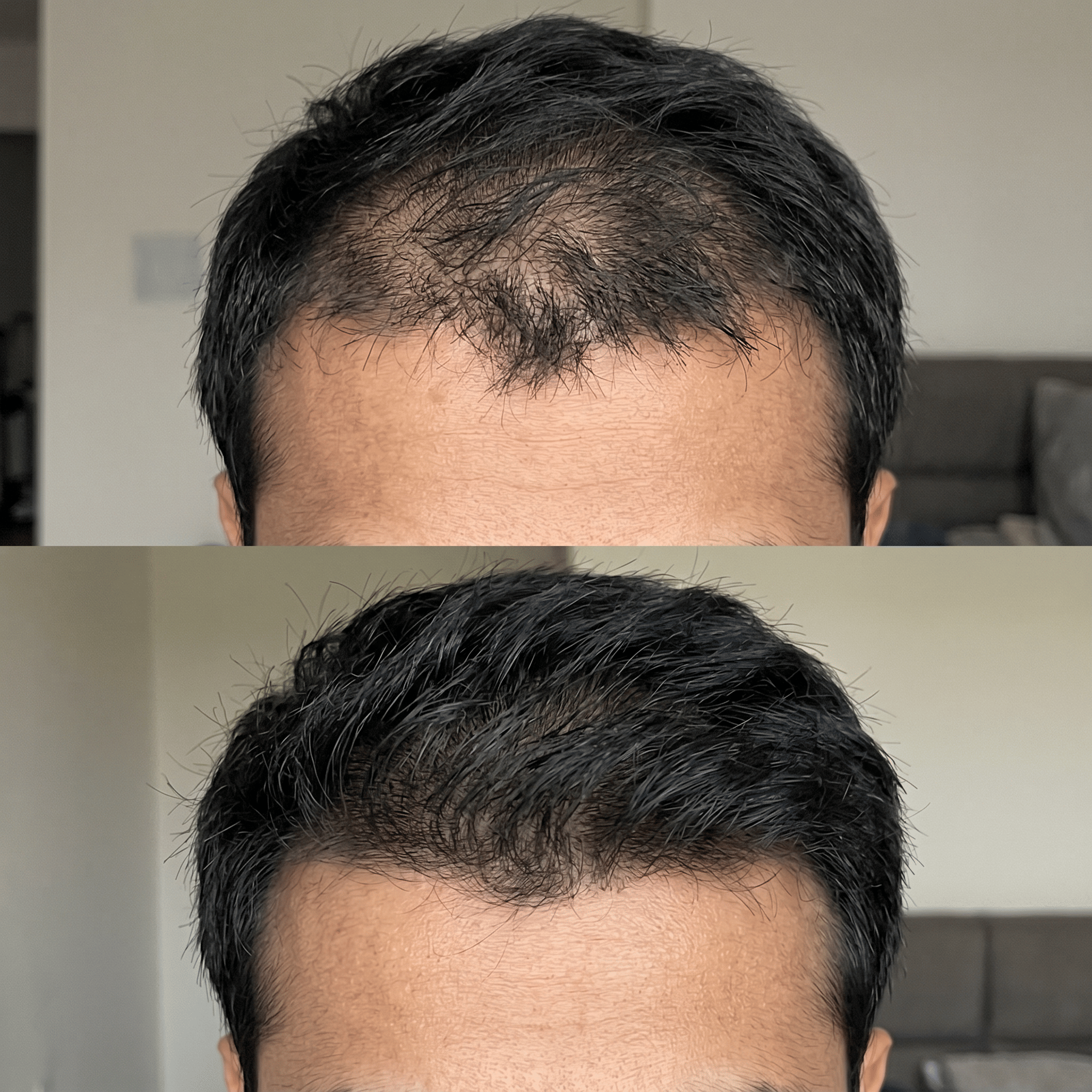
No overnight fix: Minoxidil, like all hair regrowth treatments, requires steady, consistent use before you will see visible change. Results build up over time, not all at once. Those who take it regularly are the ones who see the biggest difference, not the ones who skip doses.
What Side Effects Can Oral Minoxidil Cause?
The most common side effects of oral minoxidil are hypertrichosis (excess body hair) and some cardiovascular symptoms. However, side effects such as insomnia and postural hypotension have also been reported but are less common.
In a 2024 comprehensive review of low-dose oral minoxidil these side effects are divided into two groups:
- Dose-dependent effects become more likely as dose increases. These include hypertrichosis and cardiovascular symptoms such as rapid heartbeat or fluid retention.
- Idiosyncratic effects, which are rare and are not dose related. The review mentions rare reports of pericardial effusion, which is the accumulation of fluid around the heart.
Real world data provides valuable context. Mild hypertrichosis was observed in some patients treated with low-dose oral minoxidil for androgenetic alopecia in a series of 435 patients, with isolated reports of insomnia and postural hypotension (lightheadedness on standing). Discontinuation due to side effects was low at 1.6%.
A larger multicentre study of 1,404 patients supports the same general pattern across a mixed group of men, and found that hypertrichosis was reported more often in women.
In the Penha head-to-head trial, hypertrichosis and headache were more common with oral minoxidil than topical.
Most men are happy to trade a little more body hair or facial hair for that. For others it is not so. It’s a personal choice, and it’s better to make it before you start rather than to find out three months in.
What Side Effects Can Topical Minoxidil Cause?
The most frequent side effects of minoxidil applied to the skin are irritation, dryness and itching of the scalp. The label advises to check with a doctor about sudden or patchy hair loss or scalp redness/burning.
The NIH’s DailyMed hosts the drug label for topical minoxidil, which has clear reasons to see a doctor:
- Loss of hair in patches or suddenly.
- Red, inflamed, irritated or painful scalp.
- Pregnancy or breastfeeding, as this product may cause harm.
The label also reminds the user that topical minoxidil is only for use on the scalp.
In the Penha trial, there was more itching and eczema in the topical group than the oral group. That fits with the general picture: problems with topical minoxidil tend to be localized to the region of application.
The main reason for less systemic exposure of topical minoxidil compared to oral is poor absorption. The full review on minoxidil states that only ~1.2-1.4% penetrates the skin. But low absorption does not equal zero absorption and zero side effects.
Because topical minoxidil's side effects show up on the scalp, the formulation matters as much as the molecule. The alcohol and other solvents in many minoxidil solutions can dry and irritate the scalp, and a routine your scalp can't tolerate is a routine you won't keep up. That is why Man Matters offers alcohol-free, water-based minoxidil, formulated to lower the chances of irritation and redness.
For a lot of guys, the everyday downside of topical minoxidil isn’t medical. The cycle is: oily or sweaty scalp, squashed hair, putting it on twice a day around work and the gym. Mild irritation is common and generally manageable. If irritation keeps getting worse, that’s a reason to get it looked at rather than push through.
Why Is Oral Minoxidil Taken Under a Doctor’s Supervision?
Oral minoxidil is systemic in action, hence it is prescribed under a doctor’s supervision. In the review of low-dose oral minoxidil, the rationale for supervision is explained. Some of the side effects are dose related and the dose must be chosen with care. Others are rare and unpredictable, so any symptoms should be taken seriously if they occur. Both are reasons to have a doctor consultation from the start.
In practice, your doctor will want to know information about your heart health, blood pressure history, other medicines and any symptoms before prescribing oral minoxidil. It’s not about putting up barriers. To make sure a medicine that works on the whole body is a good fit for your whole body. And supervision doesn’t stop with the first prescription. Check ins is where doses get reviewed, where early concerns get caught. A plan is something you stay in, not something you buy once.
The good news is there is a lot of real world data. The multicentre study of 1,404 patients gives a broad safety context for low-dose oral minoxidil in hair loss. However, that study is observational, not a randomized comparison, so it can’t tell us how any one person will respond.
This is also where many men get caught up. They want a clear plan, not a discussion. A dermatologist can let you know if oral minoxidil is even an option for you, and if other treatments are part of the conversation. If you’re considering more than one option, our guide to minoxidil and finasteride and which is more effective for hair growth takes that on.
Can Oral Minoxidil and Topical Minoxidil Be Used Together?
A dermatologist may prescribe both routes together in some cases, but there is no dedicated trial that directly assesses routine oral+topical combination.
That gap's important. None of the studies reviewed for this article examined the use of both routes together as a standard way of doing things. So there’s no evidence here that using them together improves results, and no evidence on the safety of combined exposure.
There are lots of men out there who talk about their “stack.” Some use a tablet and scalp solution. Some others. Some add everything they've read about. The problem with making your own combination is simple. If something gets better, you won’t know which part helped. If you have a side effect you won't know which part it was. A plan designed specifically for your own scalp and health history will always trump a stack thrown together from other men’s forum posts.
If you are curious about combining routes it is worth bringing up in a Man Matters consultation where a dermatologist can look at your history and tell you if a combination makes any sense at all.
Is 2.5 mg Oral Minoxidil Enough for Hair Loss?
There is no single answer to the question of whether 2.5 mg is appropriate, the dose being dependent on the condition being treated, the clinical context of the patient and the judgment of the prescribing clinician.
The low-dose oral minoxidil review states that a typical starting dose range is 1-5 mg per day with a maximum typically around 5 mg per day. It also describes the effect as being dose-dependent. To summarize, a more dose may do more, but it may also do more side effects.
And that’s why the answer to “is 2.5 mg enough?” is not one size fits all. For one man, 2.5 mg might be a fair dose. Again, a doctor might choose otherwise. It is contingent upon the type of hair loss and stage, health history and how someone responds over time.
Man Matters Hair Growth Tablets (30N) is a prescription-only oral minoxidil, to start your journey on hair loss after prescribed doctor consultation. Each tablet contains 2.5 mg of the active ingredient and is taken once daily after a meal, ideally at a fixed time so it becomes a habit. Because it is a tablet, there is no scalp application: no twice-daily routine around work and the gym, and no solvent-related dryness on the scalp. The visible change typically takes around 4-6 months of regular use, which fits the reality that results build slowly rather than overnight. It's easy to get tempted to compare doses with other men online, but the right dose for someone else's scalp, heart and hair loss tells you very little about your own.
Oral vs Topical Minoxidil: In Which Situations Is Medical Advice Necessary?
If you develop sudden or unexpected hair loss, redness/burning/pain in the scalp, or symptoms such as heart palpitations/swelling after beginning oral minoxidil, you should see a doctor immediately.
Seek medical advice promptly if you notice:
- Sudden, patchy or unusual hair loss (see label of topical minoxidil).
- Redness, burning, pain or irritation of the scalp.
- Heart palpitations, racing heart rate, or new swelling after starting oral minoxidil, which the low-dose oral minoxidil review associates with its cardiovascular effects.
- Trouble sleeping, reported in the 435 patient cohort • Lightheadedness on standing, reported in the 435 patient cohort
It’s perfectly normal to feel lost with so many doses and opinions out there. A dermatologist can help you cut through the noise and figure out what’s causing your hair loss, so you can treat what you need to and skip what you don’t.
That's what a consultation is for. It’s not about being handed a stronger product. It’s just having someone finally tell you what’s going on and what to do next which for most men is the missing part. The free 1-minute Man Matters hair assessment is one way to begin that conversation.
Frequently Asked Questions
Is there a downside to oral minoxidil?
Yes. Oral minoxidil is a systemic drug, and so side effects such as hypertrichosis, cardiovascular symptoms and, less often, insomnia or postural hypotension, can occur, according to a 2024 review and a 435-patient cohort.It might not be the best choice for everyone.
Is 2.5 mg oral minoxidil enough for hair loss?
It is contingent upon the person. The 2024 review states the usual starting range for low-dose oral minoxidil is reported to be 1-5 mg per day, and its effect is considered dose-dependent. So 2.5 mg may be good for some but not for others. The right dose is a decision for the prescribing doctor, based on the person’s history of hair loss and health.
Why won’t doctors prescribe oral minoxidil?
Some doctors are hesitant to prescribe it because the FDA has not approved oral minoxidil for hair loss and its use for alopecia is off-label. A 2024 review says it also works on the whole body, so there may be a need for cardiovascular monitoring. That is not a blanket rule. Prescribing is a clinical decision on a case-by-case basis.
Can I use oral minoxidil as well as topical?
Sometimes the doctor may give both routes together. However, the evidence reviewed in this article does not include a direct trial specifically assessing a routine combination of oral and topical minoxidil. There is no clear evidence on added benefit or combined safety. If you are considering using both, consult your dermat before you start.
How long does topical minoxidil take to show results?
The topical minoxidil label states that it takes a few months of consistent use before you notice a change and that results vary from person to person. Any growth obtained can be slowly lost if use stops.