
Minoxidil vs Finasteride: Which Works Better for Hair Regrowth? (2026)
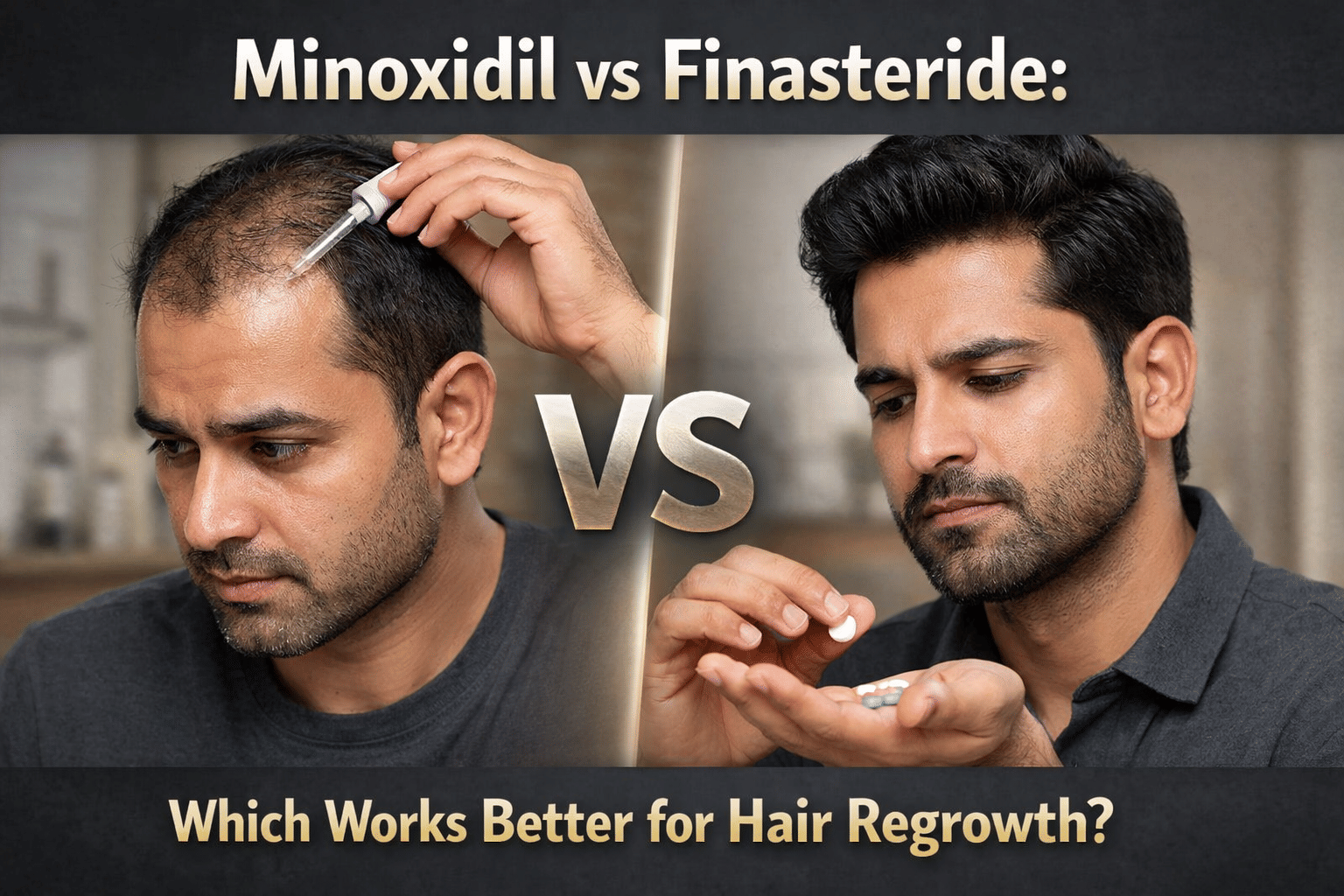
The Quick Answer
Choose Minoxidil if:
- You want visible regrowth quickly (3-6 months)
- You're worried about hormonal side effects
- You prefer topical over oral medication
- You have patchy areas you want to fill in
Choose Finasteride if:
- Your main goal is stopping further loss
- You're okay with a daily pill or topical application
- You want long-term prevention
- You're willing to wait 6-12 months for results
Use Both if:
- You want maximum results (85-90% success)
- You have moderate to advanced hair loss
- You're serious about comprehensive treatment
- You can commit to consistent daily use
How They Work: Different Mechanisms
Minoxidil: The Growth Stimulator
What it does:
- Opens blood vessels around hair follicles
- Increases nutrient and oxygen delivery
- Extends the growth phase of hair cycle
- Wakes up dormant follicles
Think of it as: Fertilizer for your scalp. Helps things grow, but doesn't fix the root problem.
Active mechanism: Vasodilator Application: Topical solution, twice daily Results timeline: 3-6 months
For a complete understanding of how minoxidil works at different concentrations, review the detailed minoxidil 10% clinical guide.
Finasteride: The DHT Blocker
What it does:
- Blocks conversion of testosterone to DHT
- Reduces scalp DHT by 60-70%
- Prevents follicle miniaturization
- Stops the actual cause of male pattern baldness
Think of it as: Fixing the leak. Stops further damage, allows natural recovery.
Active mechanism: 5-alpha reductase inhibitor Application: 1mg pill daily OR 0.1% topical twice daily Results timeline: 6-12 months
The topical finasteride 0.1% option provides similar efficacy with significantly fewer systemic side effects compared to oral administration.
Clinical Data: What Studies Show
Study 1: Monotherapy Comparison (2020)
1-year study of 600 men with androgenetic alopecia:
Minoxidil 5% Group:
- 63% showed improvement in hair count
- Average increase: 16.4 hairs per cm²
- Best results in crown area
- 40% of new hair was visible terminal growth
Finasteride 1mg Group:
- 90% stopped further hair loss
- 65% showed improvement in hair count
- Average increase: 14.8 hairs per cm²
- More even distribution across scalp
Key Finding: Minoxidil slightly better for regrowth, Finasteride much better for prevention.
Study 2: Combination Therapy (2021)
18-month study comparing monotherapy vs combination:
Conclusion: Combined therapy nearly doubles the results compared to either treatment alone.
Efficacy by Hair Loss Stage
Early Stage (Norwood 1-2)
Minoxidil:
- ⭐⭐⭐⭐ Excellent for prevention
- May be sufficient as sole treatment
- Low risk, visible results
Finasteride:
- ⭐⭐⭐⭐⭐ Best for stopping progression
- Prevents future loss effectively
- Long-term protection
Recommendation: Start with finasteride for prevention, add minoxidil if you want active regrowth.
Moderate Stage (Norwood 3-4)
Minoxidil:
- ⭐⭐⭐⭐ Very effective for regrowth
- Can fill in thinning areas
- Works best at 10% concentration
Finasteride:
- ⭐⭐⭐⭐⭐ Essential to stop further loss
- Allows natural recovery in many areas
- Must-have at this stage
Recommendation: Use both. This is where combination therapy excels. For convenience, many men prefer products that combine both treatments in a single application.
Advanced Stage (Norwood 5+)
Minoxidil:
- ⭐⭐⭐ Limited effectiveness alone
- Can improve density slightly
- Won't restore full coverage
Finasteride:
- ⭐⭐⭐⭐ Still effective for prevention
- Helps maintain existing hair
- Essential before considering transplant
Recommendation: Both are necessary, but expectations should be realistic. May need transplant for significant coverage.
Side Effects Comparison
Minoxidil Side Effects
Common (10-15%):
- Scalp irritation/itching
- Dryness and flaking
- Initial shedding (2-4 weeks)
- Unwanted facial hair (if drips)
Rare (<1%):
- Rapid heartbeat
- Dizziness
- Chest pain
Severity: Generally mild, manageable
Finasteride Side Effects
Oral 1mg (15-18%):
- Decreased libido (15%)
- Erectile dysfunction (8-12%)
- Reduced ejaculate volume (5-7%)
- Mild breast tenderness (<1%)
Topical 0.1% (4-6%):
- Decreased libido (4-6%)
- Erectile dysfunction (2-3%)
- Scalp irritation (3-5%)
Important: Most side effects resolve within 2-4 weeks of stopping. Topical has 70% fewer systemic side effects.
Timeline: When to Expect Results
Month-by-Month Comparison
Months 1-3:
- Minoxidil: Initial shedding, then baby hairs appear
- Finasteride: Shedding slows/stops, no visible regrowth yet
- Combined: Shedding stabilizes faster
Months 4-6:
- Minoxidil: Visible density improvements, especially crown
- Finasteride: Subtle improvements, hair feels thicker
- Combined: Clear improvements across treated areas
Months 7-12:
- Minoxidil: Peak results achieved
- Finasteride: Noticeable regrowth begins, continued improvement
- Combined: Maximum density improvements, best outcomes
Beyond 12 Months:
- Minoxidil: Maintenance phase (results plateau)
- Finasteride: Continued slow improvement up to 24 months
- Combined: Maintenance and optimization phase
Real-World Scenarios
Scenario 1: 25-Year-Old, Early Thinning
Hair Loss: Norwood 2, slight recession
Goal: Prevent further loss
Best approach: Finasteride as primary treatment
Start with finasteride to prevent progression. Monitor for 6 months and add minoxidil if you want faster visible improvement. Understanding your hair loss stage helps determine the right treatment approach.
Scenario 2: 32-Year-Old, Moderate Crown Thinning
Hair Loss: Norwood 3, visible crown thinning
Goal: Stop loss + regrow crown
Best approach: Combination therapy essential
Use both finasteride and minoxidil from the start. Consider combination products for better consistency. Adding derma rolling weekly enhances absorption and results.
Scenario 3: 40-Year-Old, Advanced Thinning
Hair Loss: Norwood 5, significant loss
Goal: Stabilize and improve density
Best approach: Aggressive multi-treatment protocol
Combine finasteride and minoxidil as foundation, add derma rolling and ketoconazole shampoo. Consider hair transplant after 12 months of stabilization.
Scenario 4: Side Effect Sensitive
Concern: History of low libido or anxiety
Goal: Regrowth with minimal systemic effects
Best approach: Topical-focused protocol
Start with minoxidil for growth stimulation. If needed, add topical finasteride (70% fewer systemic effects than oral). Enhance results with derma rolling rather than increasing medication.
Combination Strategies
The Standard Protocol
Daily Routine:
- Morning: Apply minoxidil solution
- Evening: Apply minoxidil solution
- Daily: Take finasteride (oral) OR apply topical finasteride with minoxidil
- Weekly: Derma roll 0.5mm (skip minoxidil for 24 hours after)
Success Rate: 85-90%
Many users find single combination products more convenient and effective for maintaining consistency.
The Natural-Focused Protocol
For those minimizing pharmaceutical intervention:
- Daily: Minoxidil 5-10%
- 2-3x weekly: Ketoconazole shampoo (mild DHT blocking)
- Daily: Biotin supplementation
- Weekly: Derma rolling
Success Rate: 65-75%
Common Questions
Q: Can I start with just one and add the other later?
Yes. Start with finasteride (stops loss), add minoxidil after 3-6 months if you want more regrowth.
Q: Which one works faster?
Minoxidil shows visible results in 3-6 months. Finasteride takes 6-12 months but provides better long-term results.
Q: If I had to choose only one forever, which?
Finasteride. It addresses the root cause (DHT). Minoxidil only treats symptoms.
Q: Can I use minoxidil without finasteride?
Yes, but you'll continue losing hair while trying to regrow it. Less effective long-term.
Q: Can I use finasteride without minoxidil?
Yes, and many do successfully. You'll stop loss and see some regrowth, just not as much as with both.
Q: What if both don't work?
10-15% are non-responders. Consider alternatives: dutasteride (stronger DHT blocker), PRP therapy, or hair transplant.
The Bottom Line
Neither drug alone is perfect:
- Minoxidil grows hair but doesn't stop loss
- Finasteride stops loss but grows less hair
Together, they're comprehensive:
- 85-90% success rate
- Attack hair loss from both angles
- Best results seen in clinical studies
The Real Winner: Combination therapy using both
If you must choose one:
- Under 30 with early loss: Start with Finasteride
- Over 30 with visible thinning: Use both
- Worried about side effects: Minoxidil + Topical Finasteride
Remember: Hair loss treatment is a marathon, not a sprint. Commit to 12 months before judging results. Consistency beats concentration every time.