
Norwood 3 Hair Loss: What It Looks Like and How to Treat It


Norwood 3 is the stage of male pattern hair loss where the temples have clearly receded. The hairline forms a deep M, V or U shape. The middle of the front is often still in place. At classic Norwood 3, the crown is not yet bald. In the Norwood 3 vertex form, the crown also starts to thin. It is the first stage that doctors treat as real male pattern hair loss, and treatment still works well here.
What Does Norwood 3 Look Like?
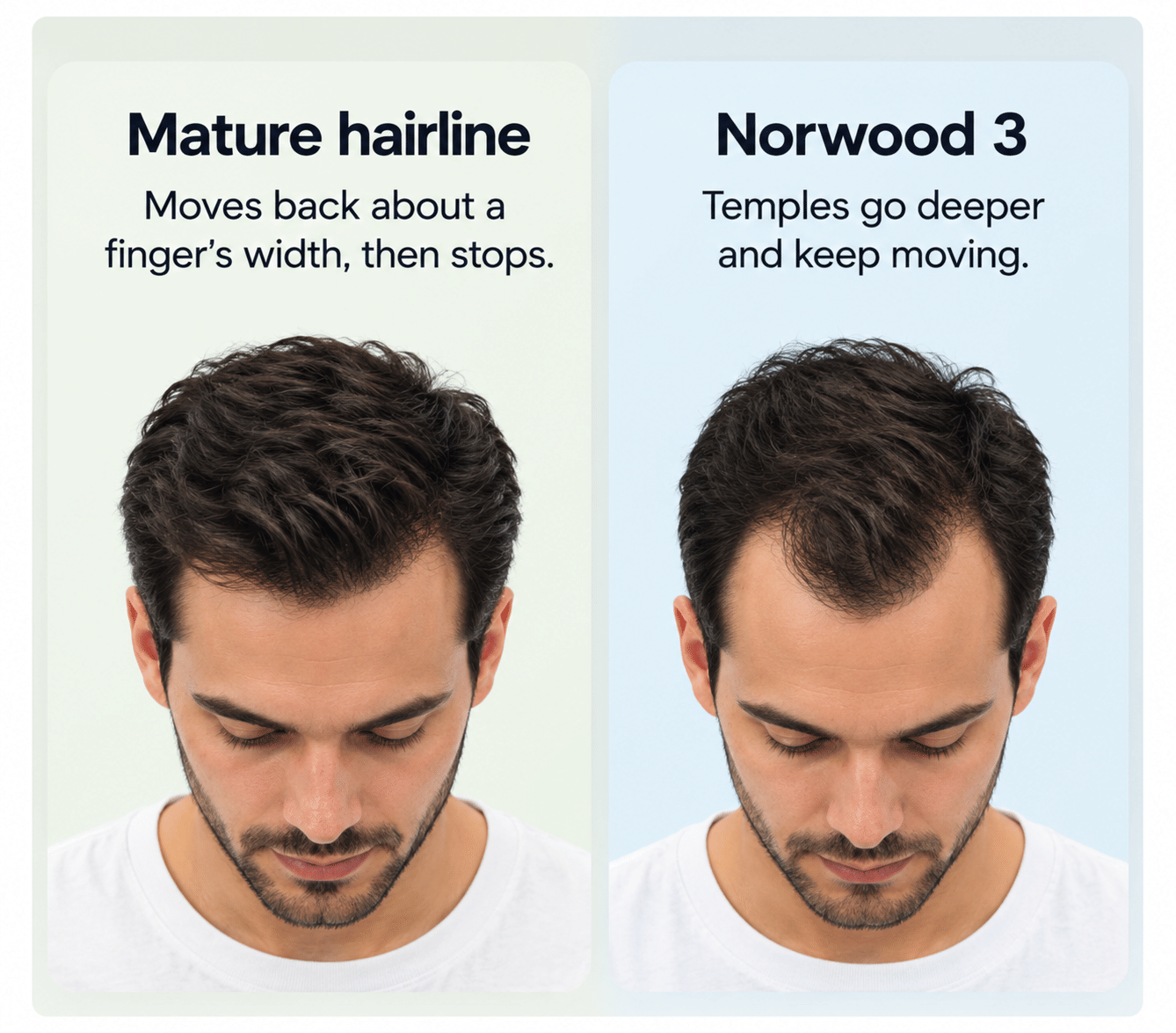
Norwood 3 shows deep recession at both temples. The corners of the hairline have pulled back well behind where they started. From the front, the hairline looks like an M or a V. Some men see a U shape instead.
The scale comes from a 1975 paper on male pattern baldness¹. It built on an older, simpler scale. It has seven main stages, from a full hairline to only a band of hair at the sides and back.
Here is where stage 3 sits on the scale:
For the full seven-stage scale, read our guide to the stages of hair loss.
What Is Norwood 3 Vertex?
Norwood 3 vertex is a version of stage 3 where the crown also thins. The temples have receded to about a stage 2 or 3 level. At the same time, a thin or bald spot appears at the top back of the head.
The front and the crown are still separate. A band of hair runs between them. In later stages, this band thins and the two areas start to join.
Crown thinning is easy to miss. You cannot see it in a mirror. Take a photo of the top of your head in good light, or ask someone to check.
Is Norwood 3 a Mature Hairline or Balding?
Norwood 3 is balding, not a mature hairline. A mature hairline moves back slightly and evenly, usually by about a finger's width. That fits Norwood 2. At Norwood 3, the temples go much deeper, and the change keeps going.
A few signs point to stage 3 rather than a settled hairline:
- The temple corners keep moving back over months.
- Hair at the front looks finer and see-through.
- Your hairline looks clearly different from photos taken two or three years ago.
- Close family members have male pattern hair loss.
If you are unsure, a dermatologist can look at your scalp up close. Thin, shrinking hairs among normal ones are a sign of male pattern hair loss.
How Common Is Norwood 3 in Indian Men?
Norwood 3 is one of the most common stages Indian men are diagnosed at. A 2007 study looked at 150 Indian men with pattern hair loss at a Delhi skin institute. Norwood 2 (28%) and Norwood 3 (15%) were the most common types. Older men in it had more advanced stages.
The same study found that 18% of men did not fit any Norwood type. Indian men often show patterns the scale does not describe well. This is one reason a doctor's exam matters more than matching a chart.
How Fast Does Norwood 3 Progress?
No one can predict the exact speed. Some men stay at Norwood 3 for years. Others reach Norwood 4 or 5 within a few years. Your age, your genes and when the loss started all play a part.
What is clear is that untreated male pattern hair loss tends to move forward. In the 1998 finasteride trials of 1,553 men aged 18 to 41², men on the placebo kept losing hair over two years. A five-year international study of finasteride 1 mg³ found the same over a longer time. Men in its placebo group showed progressive hair loss.
The stage you are at when you start matters too. Man Matters consultation data from 7,04,152 men (Aug 2025 to Aug 2026) shows that 65.2% were already at Norwood 3 or beyond at their first consult. That is about 2 in 3 men. Many men wait until the change is obvious before they seek help.
Can You Treat Norwood 3 Without Surgery?
Yes. Finasteride and minoxidil, alone or together, can slow further loss at Norwood 3 and help some men regrow hair. Follicles at this stage are shrinking but often still alive. That is why treatment tends to work better now than at stage 5 or 6.
Two medicines have the strongest proof. Finasteride is a tablet that lowers DHT, the hormone that shrinks hair follicles. Minoxidil is a solution you apply to the scalp to keep follicles in their growth phase.
For most men, the best start is a dermatologist-led plan with finasteride, minoxidil, or both. Here is what the trials show.
Finasteride at Norwood 3
Finasteride works on the front of the scalp. Norwood 3 is mainly a hairline stage, so this matters. A 1999 study of finasteride in men with frontal hair loss⁴ found a clear rise in hair count at the front of the scalp after one year. The gains held or improved in the second year.
Finasteride slows loss over time. In the 1998 trials of 1,553 men, finasteride added 107 hairs at one year and 138 hairs at two years, compared with placebo. These were counted in a 5.1 cm² patch of scalp. Read more in our guide on whether finasteride regrows hair.
Minoxidil at Norwood 3
Minoxidil is put on the scalp, usually twice a day. The US National Library of Medicine's MedlinePlus guide to topical minoxidil says results take at least four months. It can take up to a year.
Using both together
The combination tends to work best. A 2015 trial of 450 men with pattern hair loss⁵ compared finasteride, 5% minoxidil and both together for 12 months. Hair improved in 94.1% of men on both, 80.5% on finasteride alone and 59% on minoxidil alone. Side effects were rare.

What to expect and when
Finasteride is a prescription medicine in India. The US National Library of Medicine's MedlinePlus guide to finasteride⁶ says you will probably lose the hair it regrew. This happens within 12 months of stopping. Some men report sexual side effects, so start it only under a doctor's care.
Man Matters' Minoxifin (5% minoxidil + 0.1% finasteride) puts both medicines in one solution for the scalp. It is used twice a day for at least five to six months, under a dermatologist's guidance. To compare it with plain minoxidil, read minoxidil vs minoxidil with finasteride.
Is a Hair Transplant an Option at Norwood 3?
A transplant can fill receding temples, but it is not usually the first step. It moves existing hair from the back of the head to the front. It does not stop the loss around it.
Why medicine usually comes first
Say a young man gets a transplant at Norwood 3 and takes no medicine. The hair behind his new hairline can keep thinning. That can leave a gap later. Most doctors first try to steady the loss with medicine for about a year. A transplant can then fill the temples if needed.
When Should You See a Dermatologist?
See a dermatologist as soon as you notice your temples moving back. Early treatment protects more hair. Go sooner if the loss is fast, patchy or itchy. These can point to another cause.
On the Man Matters app, you can talk to a dermatologist. They check your family history, lifestyle, diet, sleep and a photo of your hairline. Then they find the root cause and your exact stage. Only then do they set the right treatment. When you buy minoxidil or finasteride from Man Matters, you get a free pass to talk to a dermatologist.
Hair loss is common, and Norwood 3 is not the end of the road. The men who see lasting change follow a plan built for their diagnosis. They take it as directed, keep up the basics, and give it at least six months to a year.
Frequently Asked Questions
What does stage 2 hair loss look like?
Stage 2 hair loss, or Norwood 2, shows mild, even recession at both temples. The hairline moves back by about a finger's width and often forms a soft M. The front and crown still have full hair. In many men, it is simply a mature hairline that stops there. If the temples keep moving back, it can lead to Norwood 3.
Is balding genetic?
Male pattern balding is mainly driven by your genes and the hormone DHT. Genes can come from either parent. Stress, illness and poor diet can also cause hair fall. That is a different, often short-term problem. A dermatologist can tell which type you have.
Is Norwood 4 too late?
No, though results are usually smaller than at Norwood 3. Medicine can still slow loss and thicken thinning areas. Areas that have been bald for years respond less. Some men at Norwood 4 combine medicine with a hair transplant, guided by a doctor.
What does male pattern baldness look like?
Male pattern baldness follows a set pattern. It usually starts with a receding hairline at the temples, thinning at the crown, or both. Over the years, the front and crown can thin further and join. Hairs get finer before they are lost. Sudden, patchy or round bald spots are different and need a dermatologist's check.