
What is DHT and Why It Causes Hair Thinning in Men


If you've spent any time researching male hair loss, you've seen DHT mentioned again and again. Treatments block it. Shampoos target it. Serums are built around fighting it. But most explanations skip straight to the solution without actually explaining the problem.
Understanding DHT - what it is, how it's produced, and why it causes some men to go bald while others don't - is the foundation for every hair loss treatment. Here's the full explanation.
What Is DHT?
DHT stands for dihydrotestosterone. It is an androgen - a male hormone - produced in the body when free testosterone is converted by an enzyme called 5-alpha reductase.
This conversion happens in several tissues: the prostate, skin, liver, and most relevantly for hair loss - the scalp. 5-alpha reductase is present in the sebaceous glands and skin cells of the scalp, and it continuously converts a portion of available testosterone into DHT throughout adult life.
DHT is not inherently harmful. It plays an important role in male development - including the development of male characteristics during puberty. The problem is what it does to hair follicles in men who are genetically sensitive to it.
Your hair loss has a specific stage. Find out which one.
Free 3-minute assessment. Dermatologist -reviewed. Stage-matched treatment plan. No payment required.
[Take the Free Hair Assessment]
How DHT Shrinks Hair Follicles
In men with androgenetic alopecia (male pattern hair loss), hair follicles carry androgen receptors - proteins on the follicle cell surface that DHT can bind to. When DHT binds to these receptors, it triggers a biological cascade that progressively miniaturises the follicle.
Here's what that process looks like over time:
- DHT binds to androgen receptors in the dermal papilla - the follicle's control centre
- This reduces growth-supporting proteins including growth factors like IGF-1
- The anagen (active growth) phase shortens with each cycle
- Each successive hair is thinner and shorter than the last
- Eventually the follicle enters a permanent resting state and stops producing visible hair
This process is called follicle miniaturisation, and it is the core mechanism behind male pattern baldness. It is gradual, progressive, and - in the absence of treatment - irreversible once follicles have fully closed.
Why Does DHT Affect Some Men and Not Others?
This is the question most men have. Everyone produces DHT. But not everyone goes bald.
The answer lies in genetic sensitivity. Men with androgenetic alopecia inherit a higher density of androgen receptors in their scalp follicles, or receptors that are more sensitive to DHT even at normal circulating levels. Their follicles respond more aggressively to DHT binding - miniaturising faster and with greater coverage.
This predisposition is inherited from both parents - not just the mother's side as the common myth suggests. The relevant gene variants affect androgen receptor sensitivity and 5-alpha reductase activity. Two men with identical DHT levels can have completely different hair outcomes based purely on follicle receptor sensitivity.
 Man Matters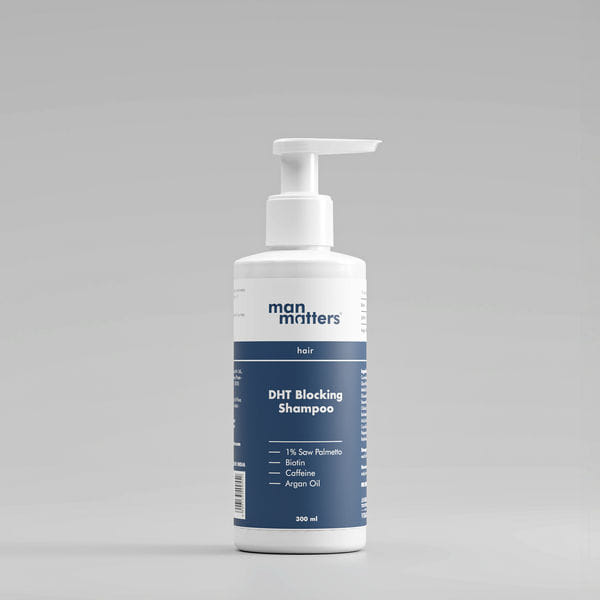
The Role of 5-Alpha Reductase
Since 5-alpha reductase is what produces DHT, it's the target of most DHT-blocking treatments. The enzyme exists in two forms:
- Type I — present primarily in scalp skin and sebaceous glands
- Type II — present in the prostate and hair follicle tissue
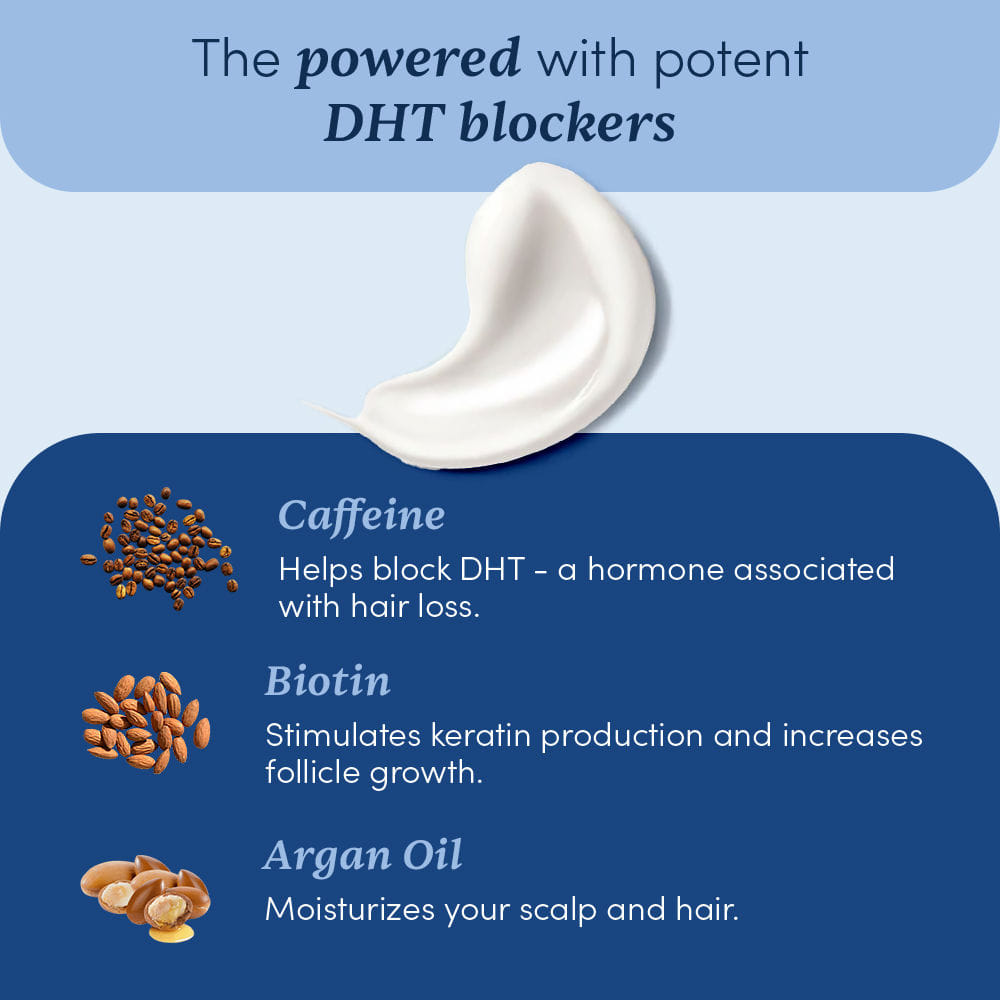
Pharmaceutical blockers like Finasteride target Type II specifically. Natural inhibitors like Saw Palmetto and the Oleanolic Acid in Procapil act primarily on Type I - the form most concentrated in scalp tissue.
Blocking 5-alpha reductase reduces DHT production at the scalp. Less DHT means less binding to follicle receptors. Less binding means slower miniaturisation. This is the logic behind all DHT-blocking hair treatments.
DHT and Hair Loss Pattern: Why the Top of the Head?
One of the distinguishing features of DHT-driven hair loss is its pattern. It follows a predictable route mapped by the Norwood Scale - typically beginning at the temples and crown, progressing inward, and potentially converging into advanced baldness.
This pattern exists because follicles at the top and front of the scalp carry significantly more androgen receptors than follicles at the sides and back. The permanent fringe of hair that remains even in advanced baldness persists precisely because those follicles have fewer receptors and are therefore largely DHT-resistant.
This is also why hair transplant surgery takes donor hair from the back and sides- those follicles remain resistant to DHT even when transplanted to areas that were previously balding.
Man Matters
How to Reduce DHT's Impact on Your Hair
Once you understand the mechanism, the treatment logic follows naturally. Three approaches work together:
1. Reduce DHT production at the scalp — inhibiting 5-alpha reductase via Finasteride (pharmaceutical), or natural inhibitors like Saw Palmetto, Procapil's Oleanolic Acid, and Caffeine
2. Protect follicles from structural deterioration — strengthening anchoring (Procapil), preventing perifollicular fibrosis (Aminexil), and maintaining scalp circulation (Minoxidil, Procapil's Apigenin)
3. Reactivate suppressed follicles — using stem cell activators like Redensyl that restore the follicle's internal growth signalling regardless of the external DHT environment
The strongest routines combine all three simultaneously.
At What Age Does DHT Hair Loss Typically Start?
DHT-driven hair loss can begin as early as the late teens in genetically predisposed men. Approximately 50% of men experience some degree of androgenetic alopecia by age 50.
The earlier it starts, the more aggressively it tends to progress - making early action the single most important factor in long-term outcomes.
Your hair loss has a specific stage. Find out which one.
Free 3-minute assessment. Dermatologist -reviewed. Stage-matched treatment plan. No payment required.
[Take the Free Hair Assessment]
FAQ
Q: Does high testosterone cause hair loss?
Not directly. It's the conversion of testosterone into DHT that causes hair loss - not testosterone itself. Men with higher testosterone don't necessarily lose more hair; what matters is their follicles' sensitivity to DHT and how much 5-alpha reductase activity is present in their scalp.
Q: Can DHT hair loss be reversed?
In early to mid stages, yes - with consistent use of proven treatments. Minoxidil, Finasteride, and topical actives like Procapil and Redensyl have all shown measurable hair regrowth in men with androgenetic alopecia. In advanced stages where follicles have fully closed, reversal is not possible with topical treatment alone.
Q: Is DHT the only cause of hair loss in men?
No. DHT drives pattern baldness, but hair loss is also caused by nutritional deficiencies (iron, zinc, Biotin), stress-induced telogen effluvium, scalp conditions, thyroid disorders, and autoimmune conditions like alopecia areata - each requiring a different approach.
Q: Does DHT hair loss run in families?
Yes. Androgenetic alopecia is strongly genetic, inherited from both parents - not just the mother's side as the myth suggests. Male relatives on either side with significant hair loss indicate elevated risk.
Q: How do I know if my hair loss is DHT-related?
The pattern is the most reliable indicator. DHT-driven loss follows the Norwood Scale - temple recession and crown thinning are the most common early signs. Diffuse, all-over thinning or patchy loss is more likely to have a different cause. A dermatologist can confirm through examination and, in some cases, scalp analysis.
If you're dealing with DHT-related hair thinning and want to explore clinically tested topical options - including formulas with multiple DHT-blocking actives -the Man Matters hair range is designed specifically for men with androgenetic alopecia, with stage-specific products and free expert consultation available on purchase.