
Redensyl vs Minoxidil: Which Is Better for Hair Growth?

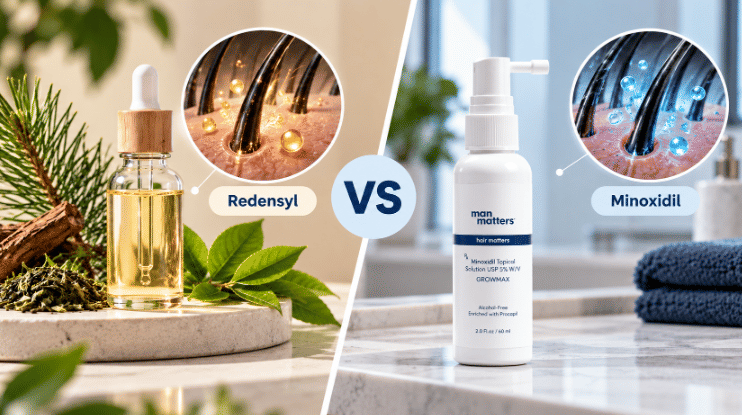
The evidence is starkly different in the redensyl vs minoxidil comparison. Minoxidil has an extensive clinical research history and is an established treatment for patterned hair loss. Redensyl has much less data. The main randomized trial it ran was of a lotion that also carried Sepicontrol A5. So the effect of Redensyl itself cannot be distinguished. The two are not synonymous. The best option depends on your type of hair loss and your health, ideally with input from a dermatologist consultation.
What Is the Difference Between Redensyl and Minoxidil?
Minoxidil is a proven topical treatment with decades of clinical research. Redensyl is a newer active with a much smaller evidence base, primarily from blended formulations. The only FDA-approved topical treatment for androgenetic alopecia (also known as pattern hair loss) is topical minoxidil.
Redensyl is an ingredient in hair lotions and serums. It’s not one of the FDA-approved treatments for pattern hair loss. A 2025 review found that Redensyl has mostly been studied in combined formulations, not alone.
Both are applied on the scalp. That’s where the comparison breaks down. These differ in terms of the evidence, approval status and what is known about safety.
If you’re on the fence, you’ve likely already tried to figure it out on your own: an ingredient list here and there, and still no sense if either is right for your hair loss. You need to know what you are treating before it helps to compare actives. So the journey begins with a short hair assessment and consultation with a dermatologist that identifies your stage of hair loss so that the plan starts with your hair, not with an ingredient.
How Do Redensyl and Minoxidil Work?
Minoxidil is believed to dilate blood vessels and prolong the growth phase of hair follicles. Redensyl is thought to work on hair follicle stem cells. Both mechanisms are hypothesized, not definitively proven.
Originally, minoxidil was developed as a medicine to treat blood pressure. Doctors noticed patients growing extra hair, which led to a topical version. Its precise mechanism is not yet fully understood. Possible pathways include opening potassium channels, stimulating blood vessel growth and protecting follicle cells.
Follicles also need to activate minoxidil into its active form with an enzyme called sulfotransferase. People have different amounts of this enzyme. This explains why you get different answers.
Redensyl consists of dihydroquercetin-glucoside from larch, a derivative of green tea, glycine and zinc. The theory is that it stimulates the follicle stem cells and pushes follicles into the growth phase. Most of the published trials evaluate Redensyl in blends, so the idea is not confirmed only for Redensyl.
What Does the Evidence Say About Redensyl?
The main trial of Redensyl was done with a lotion containing Redensyl and Sepicontrol A5, not just Redensyl.
The trial was a randomized, vehicle-controlled, single-blind study. A vehicle is the same lotion minus the active ingredients. Forty-four adults with pattern hair loss were treated with either the active lotion or the vehicle twice daily for 24 weeks. Forty-one completed, 18 men and 23 women. The hair was examined by the researchers using clinical exams, photographs, a quality-of-life questionnaire and a trichogram.
Of the 26 people using the active lotion, 7.7% had great improvement, 73.1% had moderate improvement and 19.2% remained stable. The median self-assessment score rose from 4 to 6 by week 24. The median anagen-to-telogen ratio increased from 2.25 to 4.00 to 6.02 at weeks 0, 12 and 24 respectively. The growing stage is anagen. The resting phase is called telogen. The higher the ratio the more hairs are growing.
No serious adverse events were reported. Mild itching of the scalp was noted in both groups in later review.
This evidence has clear limitations. It's one small trial. The lotion had two actives, and Sepicontrol A5 has its own proposed effects on androgen-related pathways. The effect of Redensyl on the result is unknown. The trial was terminated at 24 weeks. It does not say anything about longer use.
A 2025 review notes that studies of these actives tend to be small. Many do not have a comparison with standard therapy. Some concern conflicts of interest within companies. The same review also cites a company technical file for a trial of Redensyl alone. That source is a company file, not a peer-reviewed article.
What Does the Evidence Say About Minoxidil?
Topical minoxidil is the only FDA-approved topical treatment for pattern hair loss in men and women. It’s got strong evidence from randomized trials.
In a 48 week trial in 393 men, 5% minoxidil added 18.6 non-vellus (thicker) hairs per square centimeter. The car added 3.9.
The response is still mixed. Best for early-stage hair loss. The results also depend on the activity of the enzyme in the follicle and on the use of it. This is where men tend to lose out. The Hairfall Index, collated from 7,04,152 consultations, showed that 87.2% of hair fall consultations came from men below 35, but 65.2% of them were already at Norwood Stage 3 or above when they first came in for consultation.
Another option is low-dose oral minoxidil, which should be used under medical supervision. A 2025 meta-analysis found similar increases in hair density from oral and topical minoxidil. This article will focus on topical minoxidil.
Man Matters offers Minoxidil 5% with Procapil in a topical, alcohol-free option. It uses the same 5% minoxidil strength studied in the trials above, in a water-based formula applied as 1 ml in the morning and 1 ml at night. As with any minoxidil, steady use over months matters more than the label, and a dermatologist consultation can further tell you which option fits your stage of hair loss.
How Do the Side Effects and Tolerability Compare?
Scalp irritation including itching is a commonly reported adverse effect of topical minoxidil. Increased shedding also occurs early in treatment.
Alcohol-based solutions are more irritating, in part due to propylene glycol. The foam versions don't have this and have been linked to less irritation. Minoxidil, usually 5%, can also cause unwanted facial hair growth. Serious body-wide effects, like low blood pressure, are extremely rare in healthy people using it on the scalp.
Man Matters’ minoxidil is one alcohol-free formulation, designed to reduce the likelihood of scalp irritation and redness.
Redensyl safety data is much thinner. No significant adverse events were reported during the 24 weeks of the blend trial. This is a small study of one two-active blend. It cannot establish a general safety profile for Redensyl. Neither ingredient is without risk, and there is no evidence that either is safer.
Can Redensyl and Minoxidil Be Used Together?
Some people use a Redensyl product alongside minoxidil. Evidence for each ingredient comes from different studies. Redensyl's comes from a blend, while minoxidil's comes from stand-alone trials. Add them up and you don't get proof that the pair is better or safer.
That is why many formulations don't rely on Redensyl alone. The Man Matters Advanced Hair Serum combines 3% Redensyl with 3% Procapil, 2% Anagain and rosemary extract in a lightweight leave-on serum made for early thinning. The idea behind a formulation like this is that the actives are designed to work together to support the scalp and the look of stronger, fuller hair. It is serum, so if you already use minoxidil, check with your dermatologist on layering the two.
The problem in practice is irritation of the scalp. If your scalp is sensitive, itchy or inflamed, see a dermatologist before layering products. A doctor can look at your scalp, how far your hair loss has gone and what you are using now.
When Should You See a Dermatologist?
See a dermatologist immediately if you notice sudden or patchy hair loss, scalp inflammation, or if the hair loss continues to worsen despite treatment.
Pattern hair loss isn't the only cause of hair loss. Scarring alopecia are different from alopecia areata . Also get checked out if you have redness, pain, or signs of infection on your scalp. The cause is beyond question. Evaluate yourself before you start with either ingredient.
Hair fall is not a judgment. It’s a starting point. Man Matters who has solved for 10L+ indian men offers a hair assessment quiz to begin with.
The doctor will look at your family history, lifestyle, diet, sleep, current concerns and a photo of your hairline. They verify your prescription and evaluate your stage of hair loss. In our hair loss phases guide we explain what the phases mean. You can also book in-home blood tests, this gives your doctor more context before the plan is established.
Man Matters was built for that gap between knowing treatments exist and knowing which one is for you. The assessment, consultation and follow-ups are there to close it, no judging. When you are ready to know your stage of hair loss and the best treatment for it, start with making an appointment with a dermatologist.
How Long Can Hair-Growth Treatments Take to Show Results?
Do not make any conclusions about results until at least 24 weeks of use. A network meta-analysis indicated that benefit was more apparent if treatment was continued for at least 24 weeks.
Key trials for 5% minoxidil measured results at 16 weeks and 48 weeks. Some people notice increased shedding early in treatment. Results take time, not overnight.
There is no quick fix. Like all hair regrowth treatments, minoxidil requires continuous and uninterrupted use before any visible change can be seen. Man Matters programs for minoxidil require you to use it regularly for around six months before you can see the results. The guys who see the biggest difference are the ones who stick to it. Not the ones who miss doses.
The early weeks, when nothing yet looks different, are when routines are easiest to drop.
By age 70, up to 80% of men have pattern hair loss. You are not alone. Guesswork isn’t as good as a steady plan with doctor check-ins.
FAQs
Does Redensyl really regrow hair?
Evidence for Redensyl comes from a single small randomized trial of a lotion containing Redensyl and Sepicontrol A5, not Redensyl alone. The majority of active lotion participants improved at 24 weeks: 7.7% had great improvement and 73.1% had moderate improvement. Since the lotion was a mixture, the results cannot tell us the contribution of Redensyl alone. There is little research confirmatory.
What is more powerful than minoxidil?
There is no such clinical measure as “more powerful”. It depends who we studied, what we measured, how long the treatment lasted and what it was compared with. No trial we have seen tests Redensyl alone versus minoxidil, so no single ingredient can be a universal replacement. Your dermatologist can provide options for your case.
Can minoxidil and Redensyl be used together?
Some people use a product containing Redensyl alongside minoxidil. We found no trial that tests that combination for additional benefit or interaction safety. Do not consider combined use an evidence-based routine. Visit a dermatologist first, particularly if your scalp is sensitive or irritated.
Does Redensyl have side effects?
The only available trial of a lotion with Redensyl reported no significant adverse events during 24 weeks. A subsequent review reported mild scalp itching in both groups. This is a small study of a two-active blend so cannot confirm a general safety profile for Redensyl. Safety data specific to Redensyl for larger.
Is Redensyl backed by the same strength of evidence as minoxidil?
No. Minoxidil has a long track record of randomized trial data and a known role in the treatment of androgenetic alopecia. There is only a small trial of a blend formulation for Redensyl. Most other research tests Redensyl in combination products. The two ingredients don’t have comparable levels of evidence behind them.