
Stages of Hair Loss: The Norwood Scale Explained (Stage 1–7)

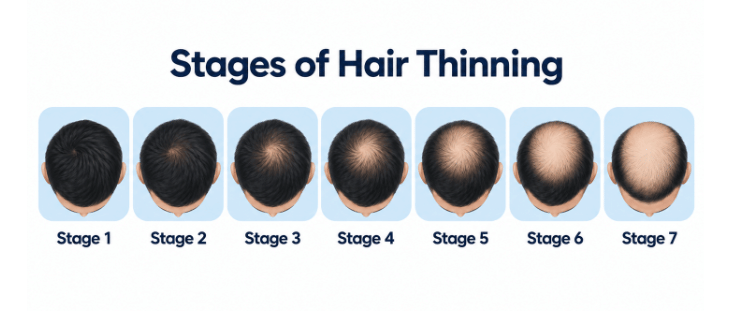
The stages of hair loss depend on the type of hair loss you have. Male pattern baldness progresses in men through seven stages, according to the Hamilton-Norwood scale, from little or no visible recession to extensive loss covering the top of the scalp. In the early stages, recession of the temples is common, while later on there is more obvious loss of hair on the crown and top of the scalp. The scale indicates the present pattern and severity, but not all of the causes of hair loss or an exact course of action for a person. Norwood staging alone doesn’t tell us much. Sudden or patchy loss needs medical evaluation.
What Are the Stages of Hair Loss?
The Hamilton-Norwood scale describes seven stages of hair loss pattern that are visible in male baldness. This is the most common way of describing the development of male pattern baldness. The same stage numbers are used by doctors, researchers and hair clinics.
What the Norwood scale measures
The scale tracks the diminishing or thinning hair – primarily the hairline, the temples and the crown and classifies these patterns into seven identifiable stages, with a Stage 3 Vertex variant. It is based on the pattern and amount of hair loss that you can see, not on blood tests, scalp biopsies or hair counts.
What the scale cannot tell you
The Norwood scale says how you look, not why you look that way. Two men at the same visible stage may have different underlying triggers, different rates of past progression and different responses to intervention. Nor can the scale assure a specific future stage or timeline – it is a snapshot, not a prediction. It is mostly relevant to classic male pattern baldness and not meant for diagnosing sudden, patchy or scarring hair loss.
Stage 1: Little or No Visible Hair Loss
Stage 1 shows no significant recession of the hairline or thereabouts and is basically the reference point on the Norwood scale. At this stage most people don't notice any change and it's not unusual for a Stage 1 hairline to look the same for years.
What the hairline typically looks like
The hairline is close to where it was in the person’s teens or twenties, with no visible notches at the temples. The hair density on the front and top of the scalp is even, and there is no thinning anywhere on the scalp when parted.
Stage 1 vs a normal mature hairline
However, it is important to differentiate Stage 1 from a “mature hairline,” which is a very mild, normal receding that many adult men experience as they age. Having a mature hairline does not necessarily mean you are experiencing pattern hair loss. It can be a natural maturation of the hairline that will not progress.
Stage 2: Early Temple Recession
Stage 2 usually shows mild recession at the temples, often referred to as a mature or adult hairline. This is one of the earliest stages men tend to notice, often because the shape of the hairline looks a little different in photos or under bright lights.
Signs to look for at the temples
The hairline is not straight but has small symmetrical notches at both temples, for a subtle “M” outline. The recession is usually mild, one or two centimeters, and at this stage the crown and mid-scalp are untouched.
When Stage 2 may not mean progressive hair loss
Not every Stage 2 hairline means you are losing hair in a patterned way. Some guys reach this point in their late teens or twenties and then plateau for a long time, because some temple recession is the natural maturation of a hairline and not an active progression. If you're trying to understand what's driving early changes at your hairline, this free hair assessment can help you understand what's behind it.
Stage 3: More Noticeable Hairline Recession
Stage 3 is a deeper temporal recession and is often the first well-defined Norwood stage of male pattern baldness. The recession here, unlike Stage 2, is usually obvious without close inspection, and it’s the stage most people associate with the phrase “receding hairline.”
What the M, U or V-shaped hairline means
At Stage 3, the temples recede even further and the shape of the remaining hairline becomes more defined, often called M-shaped, U-shaped or V-shaped depending on how much hair is left in the middle of the forehead. These shape differences don’t alter the diagnosis, they just describe how the recession appears on a particular scalp.
What Stage 3 Vertex means
Stage 3 Vertex is a variation where the thinning occurs at the crown or vertex, but the frontal hairline remains relatively intact, rather than (or in addition to) temple recession. In the Norwood classification, this is listed as a separate pattern because thinning that begins in the crown can look and behave differently than thinning that begins in the temples.
Stage 4: Frontal Recession and Crown Thinning
Stage 4 has a more pronounced recession of the frontotemporal region with visible loss of the vertex or crown but with a band of hair still separating the two areas. Stage 4 is generally considered to be a more advanced and more obvious visual stage than Stage 3.
What happens at the front
The frontal hairline recedes further back than Stage 3, and the temple notches deepen and widen. The forehead looks much larger and the other frontal hair usually forms a clear island or band shape.
What happens at the crown
At the same time, the hair on the crown thins out, sometimes so much that the scalp is clearly visible under direct light. In stage 4 the crown patch is usually well defined rather than diffusely all-over thinning
Why the separating bridge matters
A key feature of Stage 4 is that the sides are still connected to the top by a strip or “bridge” of hair that visually separates the frontal and crown areas. This bridge is often a marker. When it starts to thin or disappear, it usually means movement toward Stage 5 or beyond.
Stage 5: Wider Frontal and Crown Loss
Stage 5 shows more extensive areas of frontal and crown loss with a narrower less dense bridge between them. The bald area is larger than at Stage 4 and the parting band of hair is thinner and not so noticeable.
How Stage 5 differs from Stage 4
The frontal and crown patches grow outwards and toward each other, with the bridge of hair between them becoming noticeably narrower and thinner than at Stage 4. There's still some hair running across the top of the scalp, but it's a much smaller strip.
What becomes harder to distinguish visually
By this point it can be hard to tell at a glance where the frontal recession stops and the crown thinning starts, as the two areas are closer and separated by a thinner band of hair. This is often the point where a change of hairstyle can no longer hide the pattern completely.
Stage 6: Joined Frontal and Crown Loss
Stage 6 is when the separating bridge mostly goes away and the frontal and crown loss become one big, connected area across the top. The hairline and crown was the part of the scalp that was separated by a strip of hair, now it is mostly bald.
What the top of the scalp may look like
The scalp appears as one large bald patch from the front to the crown, with the most affected zone typically being the widest in the middle. But the hair density at the extreme margins of this area may still be slightly better than at the center.
What hair typically remains around the sides and back
The hair usually remains on the sides above the ears and on the back of the head, forming a horseshoe-shaped border. The remaining hair is often more resistant to the miniaturization seen at the top of the scalp.
Stage 7: Advanced Hair Loss
Stage 7 is the most advanced classic Norwood stage. It is marked by a thin horseshoe-shaped band of hair remaining on the sides and back. It is the furthest point on the standard Norwood scale.
What characterizes Stage 7
The crown of the scalp is almost bald at this stage, and the remaining horseshoe-shaped hair is thinner and narrower than in stage 6. The band of remaining hair usually is restricted to a lower band over the ears and around the back of the head.
Why the Norwood scale has limits at advanced stages
The scale doesn't go past Stage 7 but that doesn't mean there isn't variation in hair density from person to person within that horseshoe. This is one of several known limitations to using Norwood staging alone to describe advanced hair loss in detail.
Stages of Hair Loss at a Glance
Are All Types of Hair Loss Divided Into Stages?
No. Sudden patchy diffuse or scarring hair loss may not follow the Norwood pattern and requires a different clinical assessment. Systems for staging, such as the Norwood and Ludwig classifications, were developed to describe patterned hair loss, not all types of hair loss or shedding.
Telogen effluvium and increased shedding
The problem is seen in terms of the hair growth cycle, not a stage-based scale. Telogen effluvium is a form of increased, diffuse shedding rather than patterned recession. It often has a clear trigger like illness, stress or a major life event and usually improves once the trigger resolves, though the timeline varies by person.
Alopecia areata and patchy loss
Alopecia areata leads to hair loss in discrete, round or oval patches, not a gradual receding pattern. It does not fall into the Norwood or Ludwig frameworks at all. Usually, patchy hair loss that occurs suddenly or in an unusual shape is a cue to get an in-person evaluation, rather than trying to fit it into a stage.
Why staging alone is not a diagnosis
A stage number describes the appearance of a scalp at the present time, it alone does not confirm the reason for the hair loss. Visual staging alone is usually not enough to make an accurate diagnosis; history, examination and, if necessary, further testing are generally required.
How Do You Know What Stage of Hair Loss You Are In?
The pattern of recession and crown thinning provides the best basis for staging and should ideally be assessed consistently rather than from a single photograph. A look in the mirror (particularly in flattering light) can be misleading in either direction.
What to compare: temples, front and crown
Instead of thinking about one area, let's consider three areas together: temples, frontal hairline and crown. It’s the combination of changes across all three areas that actually maps to a Norwood stage, not any one feature on its own.
How photos can help track change
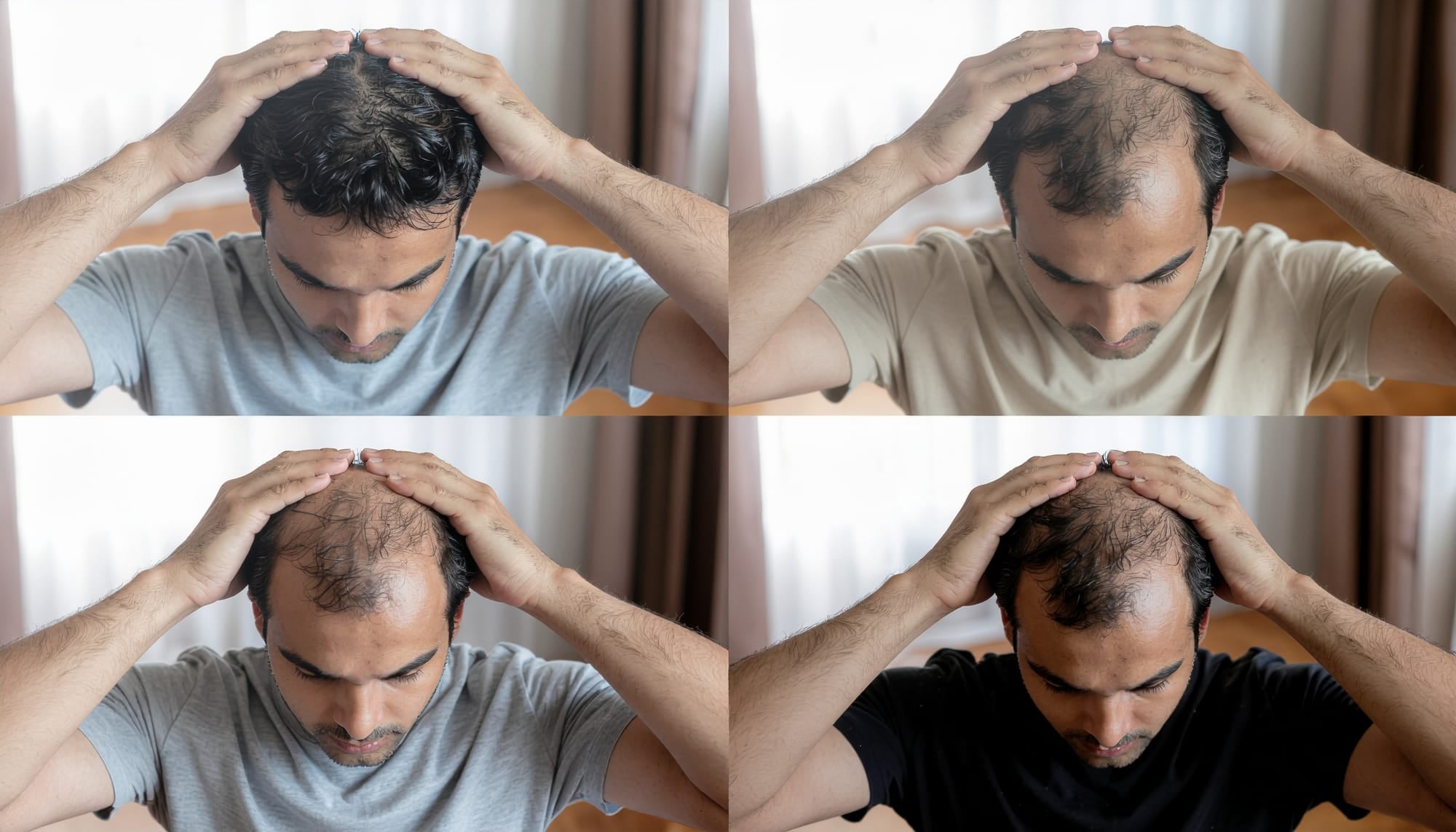
Instead of trusting memory, take photos every few months in the same lighting, angle and hair wetness and you’ll be able to see real change over time. This is especially helpful when dealing with slow-moving pattern hair loss, where it’s hard to see differences from week to week.
When self-staging can be misleading
Self-staging can be misleading if lighting, hair styling, hair length or camera angles distort the amount of scalp that can be seen. It’s also easy to over or under estimate a stage without the ability to compare side by side to reference images. If you can’t see the picture clearly, a professional assessment is more reliable than a self-diagnosis.
What Should You Do at Different Stages of Hair Loss?
Early recognition allows for earlier discussion of appropriate options, but the right next step depends on diagnosis, severity and individual factors. There is no one action that works for all stages – what makes sense at Stage 2 is different from what makes sense at Stage 6.
- Early-stage evaluation
In the earlier stages (roughly Stage 1 to Stage 3) the focus is normally on whether the recession is stable, part of normal hairline maturation, or an early sign of progressive pattern hair loss. It’s a good place to start to think about what might be affecting hair regrowth before getting into the next steps.” - More established loss
In more established stages (roughly Stage 4 and beyond), the visible pattern is usually more obvious and conversations tend to shift to realistic options for the current degree of hair loss. This is still a decision best made with proper evaluation, as options and suitability vary by individual scalp condition, medical history and stage. - When medical review matters
If the hair loss is rapid, uneven, associated with scalp symptoms or simply if you want confirmation before choosing a course of action, a medical review is more important at any stage. The general rule is to get a diagnosis before starting a treatment, and not just choose a product based on stage only.
Man Matters Product Options for Stage 1-4
Man Matters has targeted solutions for each stage 1 to 4 so you can start with an option built for where you are today. Use the table below as a starting point, not as gospel - the right fit still depends on your individual diagnosis, scalp condition and medical history, not just on stage, so it’s worth checking with a professional before you begin.
When Should You See a Dermatologist for Hair Loss?
See a dermatologist if you have an uncertain diagnosis, sudden or patchy loss, inflamed scalp or symptoms that don't fit a typical hair loss picture. Norwood staging is not intended for these scenarios, but for typical pattern hair loss.
Sudden or patchy loss
Pattern hair loss typically occurs gradually, so if you're losing hair in clumps or in distinct round patches, it's not in keeping with the pattern and is a good reason to get evaluated instead of waiting and seeing.
Scalp symptoms or rapid change
In addition to hair loss, redness, itching, flaking, tenderness or visible inflammation may suggest a scalp condition that requires its own diagnosis and management, separate from pattern hair loss staging.
Why diagnosis comes before treatment
Before choosing a treatment, it’s considered good practice to get the right diagnosis, since different types of hair loss require different approaches. If you're unsure where you stand, you can book a consultation with Man Matters' verified dermatologists to get a proper diagnosis before starting anything.
Frequently Asked Questions
How do I know my hair loss stage?
The stage is dictated by the visible pattern of frontotemporal recession and thinning of the crown, commonly evaluated using the Norwood scale for male pattern baldness. You can get a rough idea by comparing your hairline and crown to reference stage images, but a professional assessment will give a more reliable answer, especially if the pattern is unclear or mixed.
Is Stage 3 hair loss severe?
Stage 3 shows obvious recession of the temples and is often the first stage widely recognised as male pattern baldness. It's not at the advanced end of the scale, it's in the early to middle of the range. The amount of recession that will follow cannot be predicted in Stage 3.
How can I reduce hair loss?
You don't want to just grab a product or routine and not know what's causing the hair loss. The treatment depends on the cause – once identified, your dermatologist can advise you on the options best suited to your stage, scalp condition and medical history. Man Matters maps solutions to stages: Advanced Hair Serum for early thinning, Growmax for receding hairlines at Stage 2, and Minoxifin for more visible thinning at Stage 3, plus a free hair assessment to help you find where to start.
When does female pattern hair loss start?
Female pattern hair loss may begin at any number of ages, but typically presents as an overall thinning, with the crown and top of the scalp affected, rather than a frontal recession. It is usually described with a different classification, such as the Ludwig scale, as opposed to the male-focused Norwood scale.
Can hair loss stages change over time?
Pattern hair loss can advance from one stage to the next in months or years but the rate differs greatly from one person to another. "It doesn't mean somebody will get to the next stage on any particular schedule. A stage describes the current severity, not a fixed prediction."