
Which DHT Blocker Actually Works?

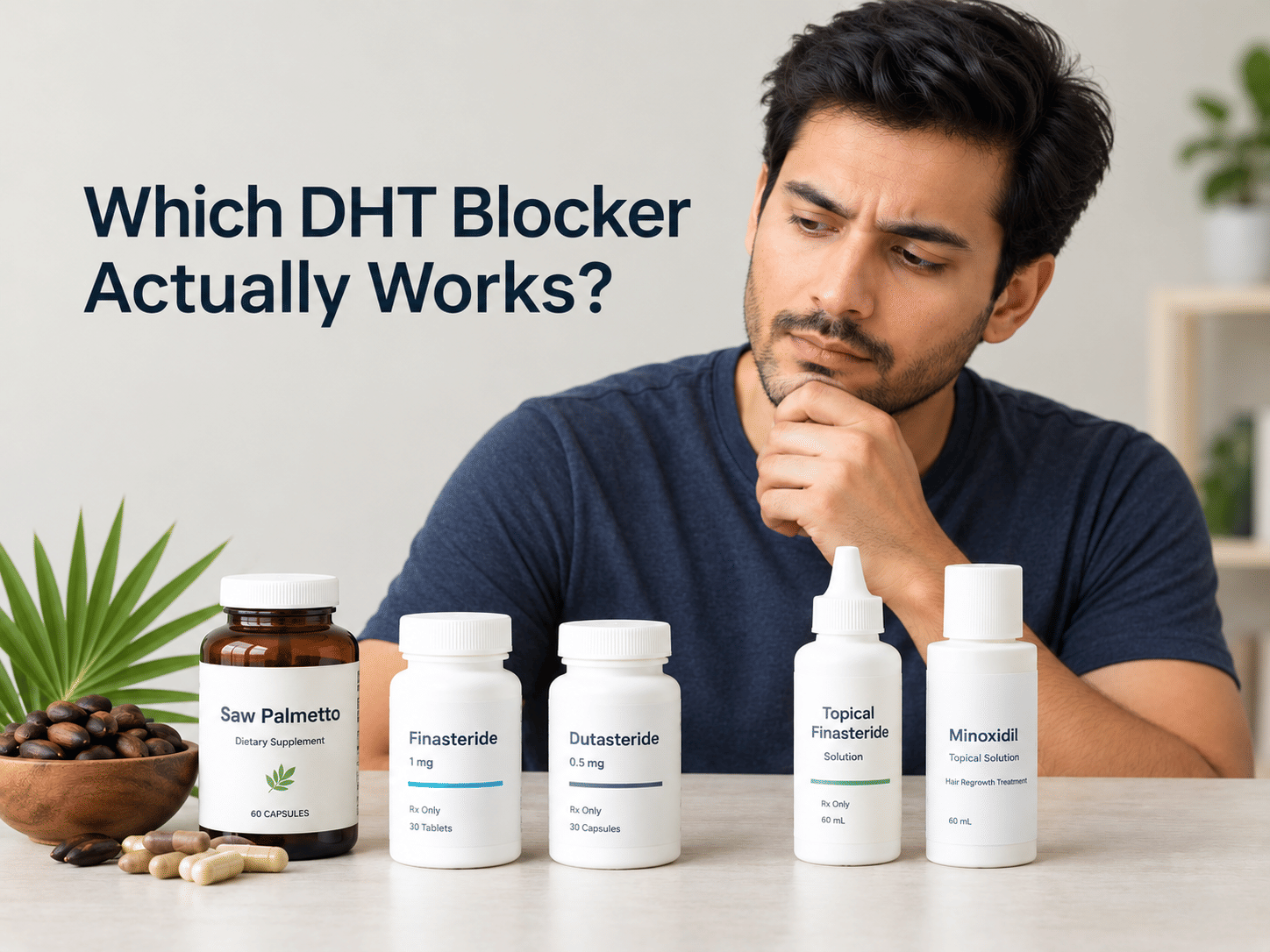
Of all the treatments that lower DHT, finasteride has the strongest evidence for male pattern hair loss. Some randomized trials have shown dutasteride to result in more hair count gains than finasteride but it is not approved everywhere for hair loss. Topical finasteride is gaining more support. Natural options, such as saw palmetto and pumpkin seed oil, have less certain evidence behind them. Minoxidil helps hair grow, but does not block DHT. The right answer for you depends on your diagnosis, the risk profile you’re comfortable with, and how strong the evidence actually is, not which bottle most confidently uses the phrase ‘DHT blocker’.
What Is a DHT Blocker, and Why Does It Matter for Hair Loss?
DHT and androgenetic alopecia
DHT(Dihydrotestosterone) slowly causes hair follicles on the scalp to shrink in genetically susceptible men, a process associated with androgenetic alopecia, or male pattern hair loss. Over time, follicles that used to grow thick strands start growing finer, shorter ones, and eventually stop producing visible hair. This is largely down to genetics and hormone sensitivity and not just diet or choice of shampoo.
What "DHT blocker" can mean
"DHT blocker" isn't a single product category. It comprises prescription drugs that block the body's production of DHT (e.g., finasteride and dutasteride), topical versions of those same drugs, and a long line of consumer products – foods, supplements and shampoos that claim some impact on DHT with much less proof.
Why the term can be misleading
Marketing tends to flatten this into one bucket, so a foods-and-supplements list can sit next to a prescription medicine as if they're interchangeable options. They are not. This guide ranks them by how strong the evidence actually is, rather than how confidently each product is marketed.
Which DHT Blockers Have the Strongest Evidence?
Finasteride
Oral finasteride is the most researched DHT blocker for male pattern baldness and has been used clinically for decades with tons of trial data available.
Dutasteride
Dutasteride is a more complete DHT blocker than finasteride. It has been shown in head-to-head trials to produce greater hair-count improvements than finasteride over 24 weeks even in younger men aged 18 to 40. A systematic review of this evidence supports the same pattern, although the approval status for hair loss varies by country.
Topical finasteride
Applying finasteride directly to the scalp is a newer approach, aimed at getting a local effect while limiting how much reaches the rest of the body. Evidence here is increasing but still less than that for oral finasteride.
Natural and OTC options
There are some human trials with saw palmetto and pumpkin seed oil but the evidence base of the non-prescription products is much more limited than the two drugs above. They are in a different evidence tier altogether, not a lesser version of the same tier.
How Effective Is Finasteride as a DHT Blocker?
What clinical trials show
Finasteride inhibits the enzyme that converts testosterone to DHT. In men with androgenetic alopecia, this means that DHT levels in the scalp are decreased. This is the mechanism behind it’s use as a first line prescription option in men with pattern hair loss.
What finasteride can and cannot achieve
Finasteride can slow further hair loss and, in many users, support some regrowth. It will not reverse advanced baldness, or regrow follicles that have completely stopped working. It doesn't work on hair loss that isn't caused by DHT sensitivity, which is why getting an accurate diagnosis is important before starting anything.
Why continued treatment matters
The effect needs to be maintained. Stopping usually means the DHT-driven shrinking of follicles can start again in time, as the drug controls the process and does not permanently cure it. Many men use finasteride in conjunction with a separate growth-stimulating treatment rather than solely relying on it, the two mechanisms address different parts of the same problem.
Is Dutasteride More Effective Than Finasteride?
How dutasteride differs biologically
Finasteride blocks one form of the enzyme that makes DHT. Dutasteride inhibits both major forms which explains its tendency to reduce DHT levels more than finasteride.
What head-to-head studies show
In head-to-head trials, dutasteride was superior to finasteride in terms of hair-count outcomes over the same period of treatment. This finding was replicated in a younger population, and confirmed by pooled analysis of several studies. “More effective in trials” is a specific, useful claim, not the same as “safer” or “the right first choice for everyone,” which depends on individual risk factors a doctor needs to assess.
Do Topical DHT Blockers Work?
Topical finasteride evidence
The rationale for using finasteride topically on the scalp is to localize the effect to where it’s needed instead of taking it orally. Early evidence suggests it can reduce DHT in the scalp and support hair growth outcomes, but the published trial base is smaller than for the oral form.
Why topical and oral exposure differ
Even topical finasteride makes it into the bloodstream to some degree, it’s not a pure local-only treatment, and should not be described as removing systemic exposure. The difference is how much is absorbed , not the fact that absorption occurs .
Limits of current evidence
Topical finasteride still requires longer-term data, standardized dosing and larger trial populations. It’s a good thing to discuss with your doctor, but not yet a definitive replacement for oral treatment in all circumstances. Some combo formulations, where topical finasteride is combined with a growth-stimulating ingredient in the same routine, are said to address DHT and growth stimulation together but that's still a decision to make with a doctor, not a default upgrade.
Do Natural DHT Blockers Like Saw Palmetto and Pumpkin Seed Oil Work?
Saw palmetto evidence
A systematic review of five randomized trials and two prospective studies found that saw palmetto supplements had some benefit for hair density in men with pattern hair loss. They were less extensive and shorter than the major studies of finasteride and dutasteride.
Pumpkin seed oil evidence
One trial gave 76 men with mild-to-moderate pattern hair loss 400mg of pumpkin seed oil daily for 24 weeks, and reported improved hair counts compared to placebo. This is one study, and a small one at that. It’s a legitimate data point, but not proof that it’s on par with prescription options.
Why natural does not mean equivalent
A larger 2026 network meta-analysis of 19 randomized trials and over 1,600 men looked at dietary supplements for pattern hair loss as a category and found the evidence still thinner than for prescription DHT blockers. Generally, smaller sample sizes, shorter trial durations and less consistent formulations are the pattern across natural options, not a flaw unique to any one product.
Does Minoxidil Block DHT?
What minoxidil actually does
Minoxidil is different from all of the above. It opens up blood vessels on the scalp and prolongs the hair growth phase. It does not alter DHT production or DHT receptors in any way.
Why it is often confused with DHT blockers
Both minoxidil and finasteride are commonly sold and used together for pattern baldness, and they both show up in the same “DHT blocker” search results, so people assume they do the same job. They don’t, they attack different parts of the same problem.
How it may be used alongside DHT-targeting treatment
Doctors sometimes combine a DHT blocker (to slow the cause) and minoxidil (to support growth) as complementary, not overlapping, tools. The right frequency for minoxidil 5% is just as important as the two products you are pairing with it. Missing doses will sabotage the results, no matter what you are pairing them with.
What About DHT Blocker Foods, Supplements and Shampoos?
What food evidence can and cannot show
Foods marketed as "DHT blockers" - like green tea, pumpkin seeds, or onions generally have weak or preliminary evidence, often from lab studies rather than trials in men with hair loss. They are not dangerous to eat but should not be considered an established therapy.
Supplements and standardized extracts
Studies with standardized extracts (like the saw palmetto and pumpkin seed oil studies listed above) are more rigorous than an unstudied hair vitamin blend. That said, the evidence base for supplements for pattern hair loss is still small compared with prescription options.
Ketoconazole shampoo as an adjunctive context
There is human evidence that ketoconazole shampoo may have an adjunctive benefit including an older comparative study against a standard shampoo. That makes sense as a supporting step in a routine, not as a standalone DHT-blocking treatment - a shampoo isn’t going to do what a prescription medicine does. If you’re looking for the specific active ketoconazole, a formulation built around it, Man Matters Keto Power Shampoo is a more relevant match for the evidence above than a general anti-hairfall shampoo would be.
Does shampoo solve for hair fall? Only when the problem starts at the scalp. In our doctor consultations, many men in their mid-20s say their dandruff gets worse in the monsoon, and an itchy, flaky scalp can add to hair fall. But dandruff has different causes: a dry scalp, a yeast called Malassezia, or lifestyle factors like stress, sweat and product buildup. Each one needs a different fix. So the first step is talking to a doctor, not picking a shampoo. If you do use one, track your progress with scalp photos every few weeks for 8–12 weeks. If it isn't working, its recommended not switch products. Go back to the same dermatologist so they can see what worked and adjust your plan.
What Are the Side Effects and Safety Considerations?
Finasteride and dutasteride
Both drugs carry a known, though uncommon, risk of sexual side effects (reduced libido, erectile changes) and mood-related effects in some users, as well as general medication risks that a doctor should walk you through before you start. Now these effects don't happen to everyone, and for most users they are controllable, but they are worth talking about up front, not after the fact.
Topical options
Topical finasteride may carry a lower risk of systemic side effects than the oral version, but the risk is not eradicated because some of the medication still enters the bloodstream. The more common local complaint is scalp irritation.
Natural/OTC products
Generally trials that have been available have reported saw palmetto and pumpkin seed oil to be well tolerated with mild digestive upset being the most common complaint. Here by “natural” we mean a different risk profile, not necessarily a safer one, supplement quality and dosing aren’t standardized like prescription drugs.
When to speak with a clinician
If hair loss is sudden, patchy or scarring, it is not following the typical pattern of DHT-related hair loss and should be properly examined before assuming that it is androgenetic alopecia. If your hair loss isn’t the classic receding-hairline, thinning-crown pattern, that’s a sign to get checked out, rather than trying to wing a routine.
Which DHT Blocker May Be Appropriate for Different Situations?
When a prescription option may be discussed
If you have a diagnosis of androgenetic alopecia and you want the most studied option, then usually the first thing a doctor will talk about is oral finasteride, with dutasteride being a possible alternative depending on your case and local approval status.
When topical or natural options may be considered
Using a shampoo with caffeine, biotin and argan oil regularly, like Man Matters DHT Blocking Shampoo, can help strengthen hair and reduce breakage-related thinning. Caffeine is the only one of the three with a DHT link, and that evidence mostly comes from lab studies. Biotin supports keratin, the protein hair is made of. Argan oil conditions the scalp and cuts down on breakage. Together they work mainly by nourishing and conditioning the scalp, not through the prescription-level DHT blocking discussed above, so treat this shampoo as a support to a doctor-recommended plan.
When DHT may not be the right target
Finasteride is the most established and widely used medicine for male pattern hair loss, despite dutasteride having a better hair-count advantage in head-to-head trials compared to finasteride among prescription options. There’s no one-size-fits-all “best” - your choice depends on your diagnosis, your risk tolerance, and current stage. A consultation with a dermatologist is the fastest way to find out which lever actually applies to you before recommending anything.
If you’re dealing with hair fall, you’re far from alone. It’s one of the most common concerns men bring to a dermatologist, and not knowing where to start is completely normal. What helps most is a shift in mindset: hair care is a routine, not a one-product fix. Men who see lasting results usually pair a treatment plan suited to their diagnosis with the everyday basics (the right shampoo, scalp care, nutrition and sleep) and stick with it consistently for months, not weeks.
Frequently Asked Questions
What is the most effective DHT blocker?
Of the prescription options, dutasteride has shown better hair-count improvement than finasteride in head to head trials, but finasteride remains the most established and widely available medicine for male pattern hair loss. There isn't one universal "best" – the right choice depends on your diagnosis, risk tolerance, and local drug approval status, which a doctor should confirm.
What is the best proven DHT blocker?
Finasteride has the strongest and longest-standing body of clinical evidence of the commonly used DHT-lowering medicines for male androgenetic alopecia. That doesn't mean it works for every cause of hair loss, it's specific to DHT-driven pattern hair loss, not hair loss in general.
Does a DHT blocker actually work?
DHT-targeting medications, such as finasteride and dutasteride, can slow hair loss significantly and encourage some regrowth in men with androgenetic alopecia. Effect size and evidence quality vary greatly by treatment. Prescription options are much better studied than natural or OTC alternatives marketed the same way.
Do DHT blockers stop hair loss permanently?
No. The benefits of finasteride, dutasteride and topical finasteride generally require continued, consistent use. Once you stop the treatment, the DHT-driven follicle shrinkage usually resumes over time. These medicines don't cure the problem, they control it.
Does minoxidil block DHT?
No. Minoxidil improves blood flow to hair follicles and prolongs the hair growth phase; it does nothing to DHT production or receptors. It is often combined with a DHT blocker such as finasteride but the two work on different parts of hair loss and aren’t interchangeable