
Man Matters · Individual Studies Series · 2026

Hairfall Index

How Indian men describe hair fall, and how it changes with age, based on Man Matters consultation data.

7,04,152 consultations · Ages 18–60+ · Aug 2025 – Aug 2026

The Insight

Millions of men have walked our doctors through their hair loss, some worried, most just unsure what’s normal. After years of these consultations, one thing is clear: hair loss doesn’t happen overnight. It moves in stages, and most men notice it later than they think. This study is a snapshot of how Indian men are living with it today.

Dive deeper

India’s men are asking for help with hair loss younger than ever.

The full findings below are published and open for verification and citation. Each figure is the percentage of respondents in that group.

Consultation volume, by age band
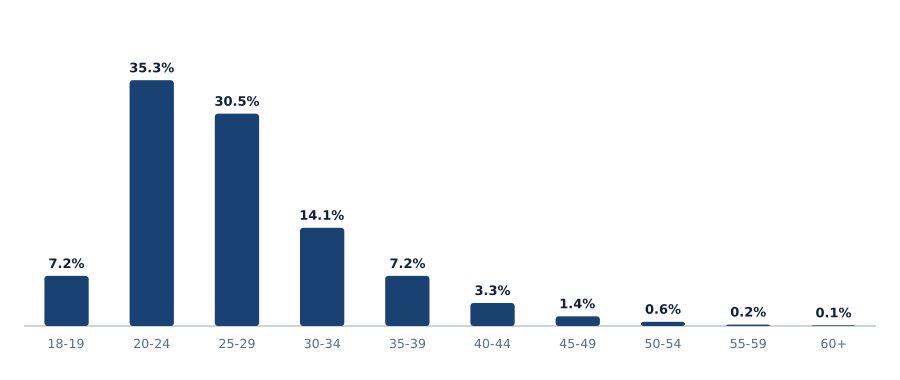
Where the 7,04,152 consultations come from
Share of all consultations, by age band
Bar chart showing consultation volume by age band, peaking at 35.3% for ages 20-24

Consultations are heavily concentrated in the 20s: 20–24 and 25–29 alone account for nearly two-thirds of the base.

Hairline in your 20s, volume in your 30s
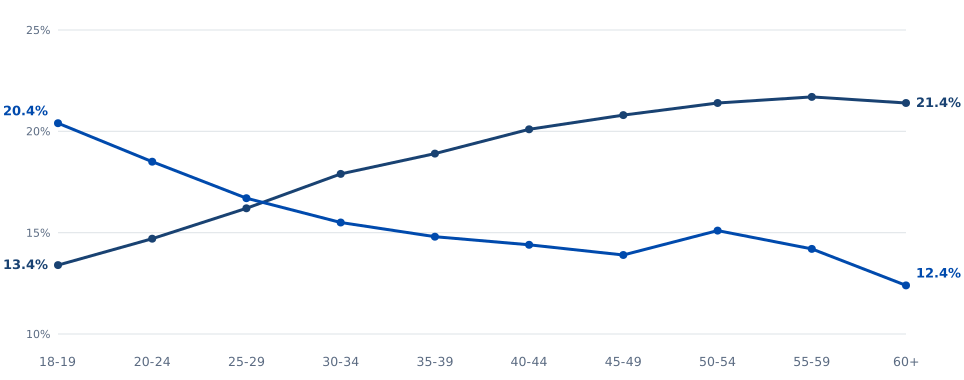
How men’s hair fall complaint flips with age
Share of the hairfall bucket describing it each way, by age band
Line chart: receding hairline language falls from 20.4% to 12.4% while thinning / low volume language rises from 13.4% to 21.7% as age increases
Thinning / low volume: 94,358 people (16.2% of the hairfall bucket) Receding hairline / low growth: 99,425 people (17.1% of the hairfall bucket)

n = 582,146 consultations in the hairfall bucket.

What this means for you

“87% of Indian men who consult for hair loss are under 35. Two in three are already at Stage 2 or beyond by the time they do. Wherever you are, the earlier a doctor sees it, the more options you have.” Dr. Sumit Upadhyay, Man Matters

Men are showing up young, and further along than you’d expect.

  • 87.2% of hairfall consultations are from men under 35, and urban India isn’t waiting for “obviously bald” to ask for help.
  • Yet 2 in 3 (65.2%) are already at Stage 3 or higher by the time they do.
  • That’s not a story about men ignoring the problem: Stage 3 is simply where a lot of men are when they first put a number to what they’re noticing, and a consultation at any stage is what actually tells you what’s going on and what the options are.

Hair loss is progressive with age. How men describe their hair loss concern at consultation changes with how old they are.

  • Below 25 (the 18–19 and 20–24 bands, roughly 42.5% of all consultations): receding hairline is the more common way to describe it, at 18.8%, against 14.5% for thinning or low volume.
  • Past 35 (every band from 35–39 up, roughly 12.8% of all consultations), that flips: thinning or low volume is more common, at 19.6%, against 14.6% for receding hairline.
  • Younger men typically notice the hairline first, the visible, specific change. As men move into their 30s and 40s, male-pattern hair loss (androgenetic alopecia) tends to broaden beyond the hairline into the crown, and the language shifts with it, from naming a specific spot early on to describing an overall sense of low volume or low growth later.
  • What starts as a hairline conversation in your 20s tends to become a density conversation by your 40s and 50s, and the earlier that shift is caught, the more options are on the table.

Six things worth knowing

Read these as patterns in who is seeking help and what they report, not as clinical prevalence for all Indian men.

Finding 01
65.8%
of all consultations come from men in their 20s. The 20–24 band alone makes up 35.3%, the biggest of any age group.
Finding 02
87.2%
of hairfall consultations are from men under 35.
Finding 03
2 in 3
are already at Norwood Stage 3 or higher (65.2%) by the time they first consult.
Finding 04
79.2%→94.3%
is how hairfall’s share of consultations rises from the 18–24 band to 55+. As age increases, so does hair loss, showcasing its progressive nature.
Finding 05
16.2%
of them report a receding hairline in their 20s.
Finding 06
13.4%→21.7%
is how “thinning / low volume” climbs from the 18–24 band to 55–59. It starts as a hairline conversation and becomes a density conversation.

Limitations

Methodology & limitations

Figures come from consultation intake data submitted by men in India who consulted Man Matters online, covering ages 18 to 60+. Concern type is read from what each man typed about his own concern at intake, grouped into buckets by keyword; near-identical phrasings were merged before analysis. Stage (Norwood 1–5) is read from the doctor’s record at consultation, where one was taken.

Every figure here is published as a percentage of its stated base, with the base size (n) shown alongside it throughout. Cuts thinner than 100 consultations are excluded or footnoted rather than charted as if they were reliable trends.

This is self-reported data from men who chose to consult Man Matters about a hair, scalp, or skin concern. It describes that group, not the general Indian population, and it shows association, not cause. Nothing here is a diagnosis or a substitute for a professional consultation.

FAQs