
How Many Hairs Is It Normal to Lose in a Day for Men?

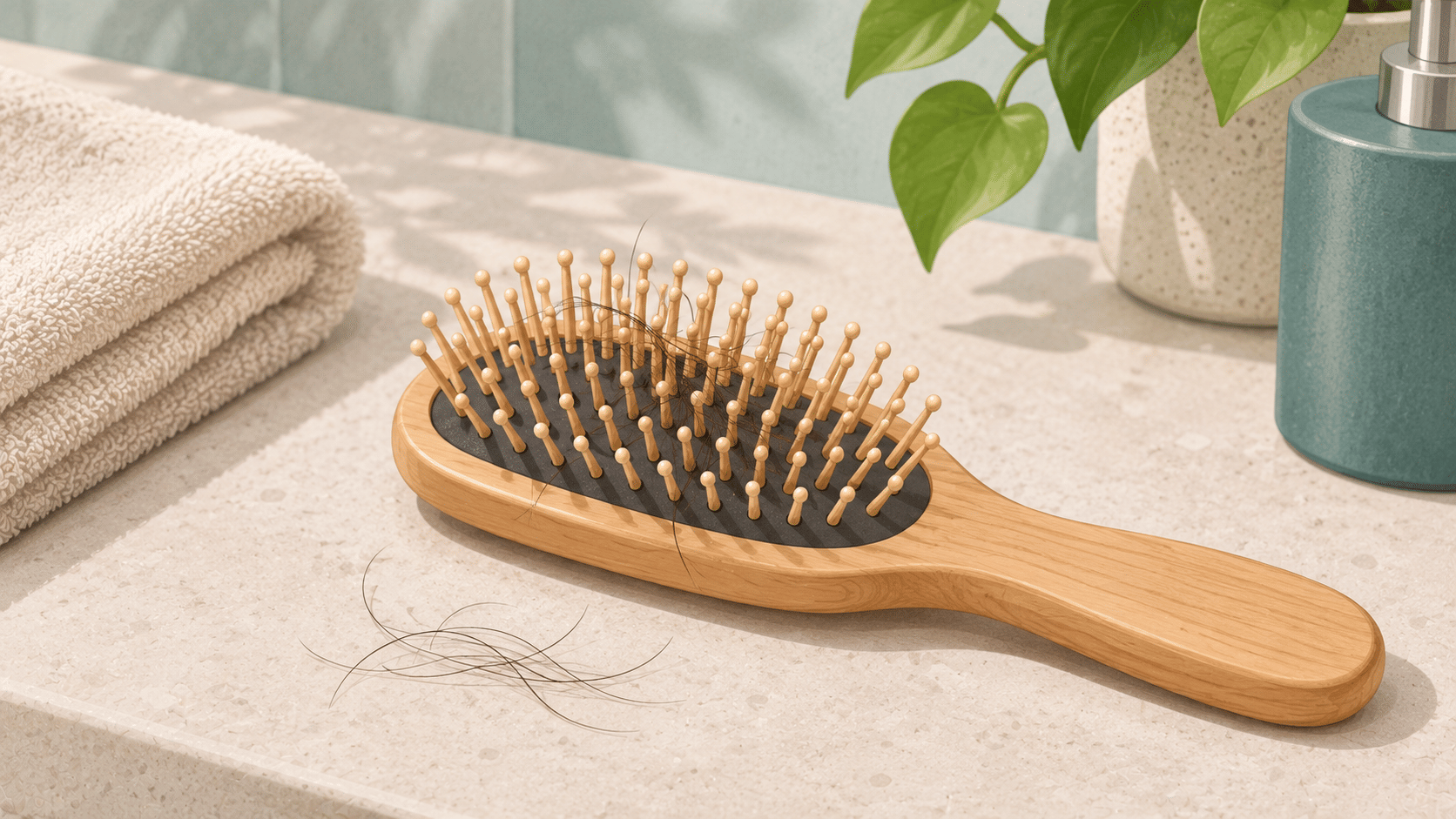
For men, losing up to 100 hairs a day is normal, according to MedlinePlus. Some medical sources cite a higher range of 100 to 200. Daily shedding is a part of the hair growth cycle.
The pattern matters more than the precise number.
See a doctor if you notice a receding hairline, a thinning crown, or sudden, patchy hair loss. Shedding after a trigger such as illness may settle over time. It is still a good idea to have it checked.
How much daily hair shedding is normal for men?
MedlinePlus puts normal loss at up to 100 hairs a day, and StatPearls gives 100 to 200. Medical references do not agree on a specific number.
Where the 100 and 100-to-200 figures come from
MedlinePlus says losing up to 100 hairs a day is normal.
StatPearls has a higher range in its physiology review. Scalp hair loss is about 100 to 200 hairs a day, it says. Both figures show the same normal process. Neither is a test result for you.
Treat them as a rough zone, not a target. Sitting in the zone doesn't mean there's no problem. Sitting outside it does not prove one. Hair length and thickness also change how many hairs you see.
Why does hair shed as part of the normal growth cycle?
All the hairs on your scalp have a growth cycle, and shedding is the last step in the cycle. So some hair fall every day is expected.
The three phases of a hair's life
Each strand goes through three phases, according to the StatPearls physiology review. The table below shows each phase and how long it lasts.
At the end of telogen, the old hair is pushed out and falls out. A new hair grows from the same follicle. That is why the cycle repeats.
Why not every hair sheds at once
Only a small share of hairs are resting at any time. A StatPearls review of telogen effluvium puts it at about 15% of scalp hairs. So some hairs are always due to fall.
What matters more than the shedding itself
What matters more is whether the shed hairs are being replaced.
Hair fall becomes a concern when new hairs come in thinner. In androgenetic alopecia, hairs become finer and shorter over time, according to a StatPearls review.
It's normal to lose some hair on your pillow or in the shower.
Why does the daily hair count vary so much?
Your daily count changes with how recently you washed or brushed, and with your hair length and density.
Hair collects in different spots. Some lands on the pillow, some on your shoulders, some in the drain and more in the brush. If you count the drain one day and the comb the next, the totals may not match.
Hair length and colour also affect what you see. On a pale floor, long dark strands look like a lot.
A receding hairline or a thinning crown is a better signal. We cover those next.

What signs mean your hair fall may be more than normal shedding?
A receding hairline, a thinning crown, clumps of hair or thin patches are better signals than a daily number.
Signs on your scalp
These changes are worth getting checked:
- A receding hairline, especially at the temples
- A crown that looks thinner or more see-through
- Hair that looks shorter or finer than before
- Patches of hair loss
- Hair coming out in clumps, not single strands
Signs on your skin and general health
Itching, redness, flaking or pain on the scalp are also worth mentioning to a doctor. MedlinePlus lists stress, certain medicines and some health conditions among the causes of hair loss.
Signs about timing
A StatPearls review of telogen effluvium describes a common type of temporary hair loss. It is a reaction to a trigger such as serious illness, major surgery, a crash diet or certain medicines.
Shedding usually happens about 3 months after the trigger. The gap can be anything from 1 to 6 months, so you might not connect the two at first.
The acute form is self-limited, and hair growth usually resumes once the trigger is addressed, according to the review. Still, get it checked rather than assume it's harmless.
The trigger and the shedding can be separated by months. A short list of recent illnesses, surgery, diets and medicines will help your doctor make the link. Bring it to the visit.
If hair loss continues for months, gets worse, or keeps coming back, get it checked. The same applies if it came on suddenly and isn't typical for you.
What these signs do and do not mean
None of these signs alone tells you what the cause is. Different conditions can appear the same, and only a clinician can tell them apart. A lower daily total does not cancel a worrying sign. A higher daily total does not create one.
Take a picture of your parting, hairline and crown in the same lighting every couple of weeks. Photos are easier to compare than memory, and they give a dermatologist a look at how quickly things are changing.
Not sure if your hairline is mature or receding? Our guide to Norwood 2 explains the difference.
If you notice any of these signs, treat them as information, not as a verdict.
Diffuse shedding vs patterned hair loss: what's the difference?
Diffuse shedding thins hair all over the scalp, while patterned loss in men usually starts at the temples and crown.
What diffuse shedding looks like
Diffuse shedding thins hair all over the scalp, without a patch of hair loss. The hair may look less full overall.
The StatPearls review of telogen effluvium ties this type to a trigger. Examples are illness, a crash diet or certain medicines. It may improve when the trigger goes away.
What patterned hair loss looks like
Male pattern hair loss is androgenetic alopecia. It follows a pattern and is generally gradual. The hairline recedes at the temples and/or the crown thins. Over time, in these areas, the hairs become finer and shorter.
According to a StatPearls review of androgenetic alopecia, it is a chronic and progressive condition. Family history increases risk. MedlinePlus Genetics links pattern hair loss to the hormone DHT.
Doctors use the Norwood scale to describe the stages of this pattern. Our guide to the stages of hair loss and the Norwood scale will show you what each stage looks like.
Why the difference matters
The difference matters because the likely cause, the likely outlook and the next step are different.
After a trigger, diffuse shedding may get better as the body recovers. Patterned loss is more likely to need ongoing attention. The cause also affects how well hair grows back.
A dermatologist can tell the difference by looking at your scalp and asking about your history. Photos of your hairline and crown from a few months ago can help a lot.

When should you see a dermatologist about hair fall?
Whatever the daily count, see a dermatologist if hair fall is persistent, sudden or patchy, or changes your hairline.
Reasons to book a visit
Make an appointment if hair loss has been going on for months or is getting worse. The same goes for a thinning crown, a receding hairline, clumps of hair or patches of hair loss.
Other reasons are itching, pain, redness or scaling of the scalp. So is persistent, severe hair loss after illness, surgery or major life stress.
This article is written for men of adult age. If you're still in your teens, talk to a doctor about any hair loss.
What to expect at the visit
Your dermatologist will carefully examine your scalp and hairline and ask questions about your history. They may ask about your family history, recent illnesses, medications, diet and stress.
The point is to find the cause. The cause dictates what happens next.
Bring photos of your hair from previous months. Bring a list of any medication you take. Both of these make the visit more useful.
Get a proper assessment
You don't have to wait until thinning is obvious. An early check can tell you whether your shedding is normal or find a cause sooner. Both answers are useful.
Not sure where you stand? A short hair self-assessment helps you note your pattern before you talk to a doctor.
If you want to get a professional's opinion, then you can consult a dermatologist on the Man Matters app. They review your family history, lifestyle, diet, sleep, current concerns and a hairline photo. Then they diagnose your stage of hair loss and set your plan.
For early hair fall, Man Matters' Advanced Hair Serum is a leave-on serum with 3% Redensyl, 3% Procapil and 2% Anagain. Give it three to six months. It's water-based; do a patch test before regular use.
Man Matters is a men's wellness platform that supports broader men's health issues by providing doctor consultations for your concerns.
The Bottom Line
Finding hair on your pillow or in the shower is a common worry. Shedding hair every day is normal. What matters is whether it is changing in a way you can see. Getting it checked early gives you a clear answer, and a clear plan if you need one.
Frequently asked questions
Is it normal to lose 150 hairs a day?
It can be. MedlinePlus says up to 100 a day is normal, and StatPearls gives 100 to 200. So 150 falls within the higher range. Visible thinning, patches or a changing hairline matter more.
How do I know if my hair loss is too much?
Look for changes you can see, not a number. These include a receding hairline, a thinner crown, patches of hair loss or clumps of hair. Shedding for months, or with an itchy, red or painful scalp, is worth checking too. Talk to a dermatologist on the Man Matters app.
Is losing 20 hairs a day normal?
Yes. It's below the 100-a-day figure MedlinePlus gives as normal. One day's count can vary with washing and combing, so watch for thinning or patches instead.
Do fallen hairs grow back?
Usually, yes. Each follicle starts a new cycle. In pattern hair loss, though, each new hair can grow back finer and shorter, which is why it needs ongoing care.