
Rosemary Oil vs Minoxidil for Hair Growth: Which Is Better?

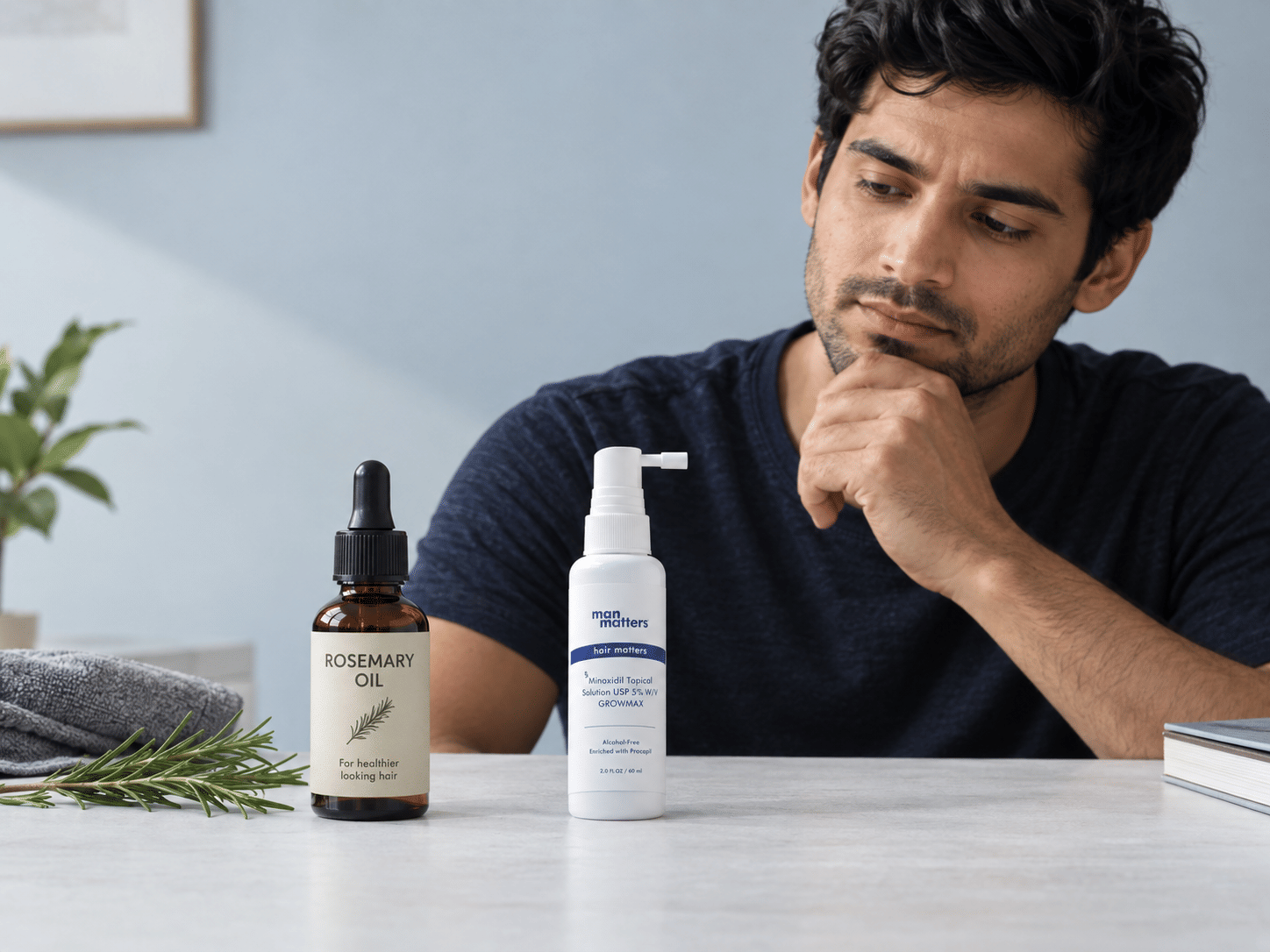
Minoxidil has a much larger clinical evidence base to support hair growth than rosemary oil. The main head-to-head study is a randomized trial from 2015. At three and six months there was no significant difference in hair count between rosemary oil and 2% minoxidil and both groups improved from baseline by month six. The trial used 2% minoxidil, so its result should not be extrapolated to 5% or oral minoxidil. Minoxidil is an established medication for androgenetic alopecia. For most men, the harder question isn't picking which oil or bottle. It’s whether they know what they’re really treating.
Rosemary Oil vs Minoxidil: Which Is Better for Hair Growth?
Minoxidil has the stronger, more established evidence base for hair growth, while rosemary oil's evidence rests mainly on a few small trials and a few reviews.
It is very common to feel lost here. Reviews, forums, oils, sprays – everything is the answer and most men end up on this comparison because they are tired of guessing. The problem for most guys isn’t really choosing between the two bottles, it’s the confusion of what would actually work for them.
Minoxidil has been researched as a hair-loss treatment for decades now. It is an established option in both topical and low-dose oral forms according to 2025 expert recommendations and a 2024 dermatology review.
Rosemary oil is newer, less thick. Its main support is a 2015 trial against 2% minoxidil, summarized by two later narrative reviews from 2024 and 2026. There is no new trial data in either review.
So "better" breaks down into two questions. How much proof exists? Minoxidil, clearly. How did the two stack up against each other? In the one trial rosemary oil matched 2% minoxidil results over six months. That is a real result, not a judgment and it doesn't extend to 5% minoxidil.
Here's how we'd weigh it: if a doctor has diagnosed male pattern hair loss, minoxidil is the stronger place to start, simply because it’s the better-researched option. Rosemary oil is worth being curious about, but it isn't a substitute for actually finding out what's causing your hair loss in the first place. A dermatologist can tell you that in one visit; guessing with oils and bottles for six months won’t.
How Does Minoxidil Work for Hair Growth?
Topical minoxidil is a hair loss treatment that acts on hair follicles via a variety of proposed mechanisms. The precise mechanism by which minoxidil stimulates hair growth has not been fully established .
Minoxidil was originally an oral medicine for blood pressure and the hair effect was discovered later. A 2024 review of minoxidil in dermatology listed several proposed pathways:
- Widening small blood vessels around the follicle (vasodilation).
- Opening potassium channels in follicle cells.
- Extending the anagen phase, the active growth stage of the hair cycle.
- Enlarging shrunken follicles so they can produce thicker hairs.
They are possible routes, not an established story. What is settled is a long clinical history in androgenetic alopecia, the medical term for male pattern hair loss. This doesn’t mean that you have to become an expert in trichology before you can make up your mind – this is precisely why a dermatologist’s read on your particular case is more important than memorising mechanisms.
Also, there are three forms of minoxidil which should not be confused: topical 2%, the strength used in the 2015 trial against rosemary oil; topical 5%, a strength more commonly used by men; and off-label low-dose oral minoxidil under medical supervision, according to an international expert consensus and dermatologist-panel recommendations. A finding of about 2% tells you about 2%. It does not tell anything reliable about 5% or oral use.
Topical 5% is a common starting point for men. Man Matters' 5% minoxidil for hair growth is one example of that strength. It is also alcohol- free which reduces irritation and redness. Where you actually land on that list isn't something to guess from a label; it's worth confirming first.
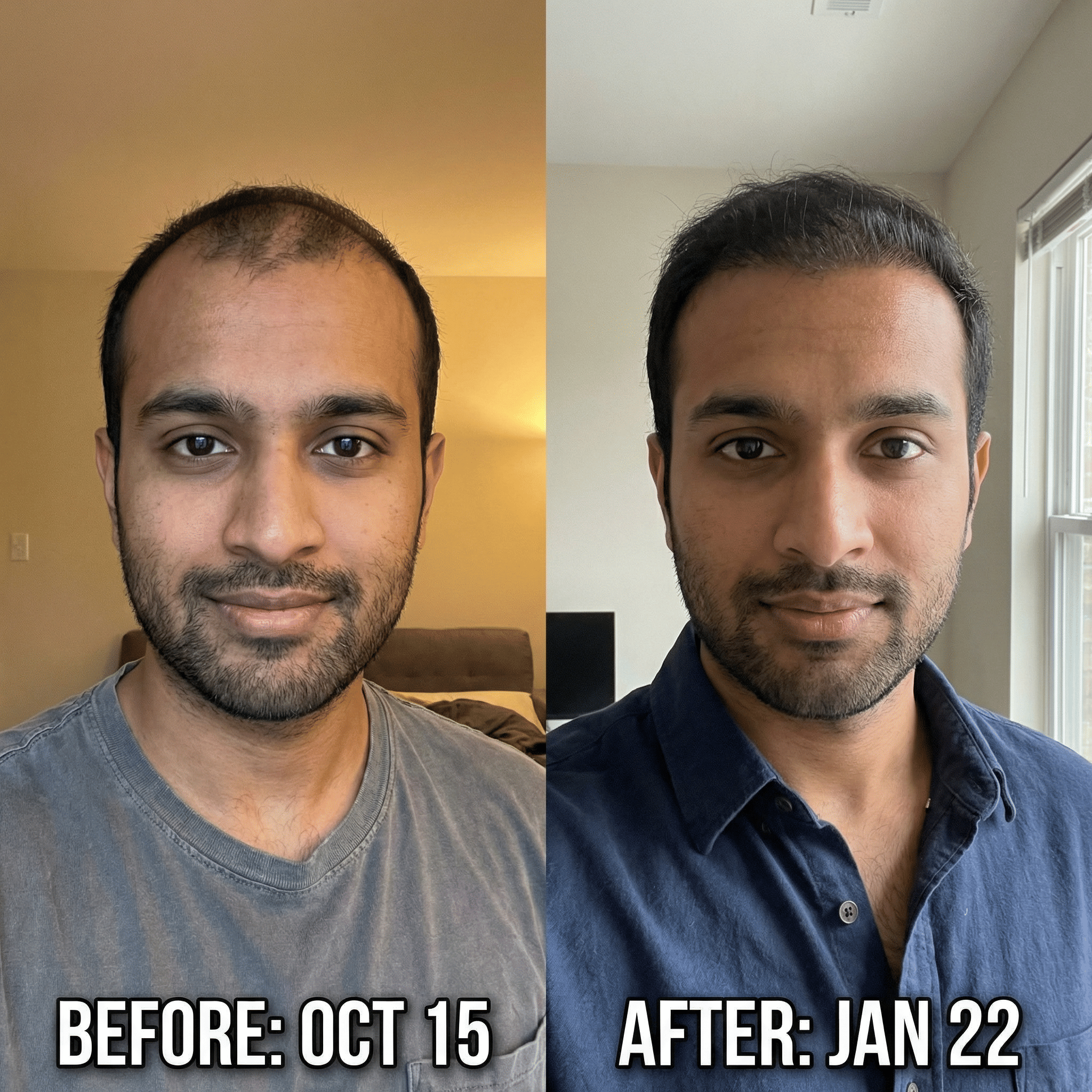
The 2025 expert panel review also clearly states that the choice between topical and oral minoxidil should be based on individual safety considerations, not convenience. On that note, the Delphi consensus on oral minoxidil is specific: the doses used for hair loss are much lower than for blood pressure. Another reason it needs a doctor's oversight, not a leftover prescription or a bottle purchased online. The decision between either oral and topical minoxidil is best for you should be taken into consideration after consulting a doctor on the platform.
Does Rosemary Oil Help With Hair Growth?
There is limited evidence for rosemary oil, primarily one randomised trial and some narrative reviews.
The trial is the 2015 comparison with 2% minoxidil, where hair counts increased in both groups by month six. That result is the main reason rosemary oil became such a popular search – it’s a simple option to reach for. No appointment, no prescription, just something you can order tonight. And that’s why it’s worth a second opinion to risk six months of consistent use.
The reviews are not offering new evidence, they are offering context. Possible effects include calming scalp inflammation and acting on the follicle itself, as reviewed in a 2024 review of natural alternatives for androgenetic alopecia and a 2026 review of natural remedies for hair growth. The logic here is that a calmer, less inflamed scalp may be a more supportive environment for hair follicles, similar logic to several other scalp-care ingredients. But that reasoning has not been borne out in large human trials for rosemary oil specifically, and the 2026 review calls explicitly for more research. Proposed mechanisms explain why researchers are interested, they don’t show rosemary oil regrows hair for most men.
There’s also a practical snag: the exact formulation of rosemary oil used in the 2015 study, its carrier and concentration, for example - could not be fully confirmed. “What you buy online may not be what was tested.”
If you do, make it a time-boxed experiment with a check-in date, not a substitute for diagnosis.
Rosemary Oil vs Minoxidil: What Does the Research Actually Show?
2015 Panahi trial compared rosemary oil to 2% minoxidil in 100 adults and found no significant difference in hair count between groups.
Panahi et al. (2015) performed a randomised comparative trial on 100 adults with androgenetic alopecia, 50 using rosemary oil and 50 using topical 2% minoxidil. The trial lasted six months, with mean hair count checked at baseline, three months and six months.
Neither group had changed substantially after three months. At six months, both groups had a significant increase in hair from baseline.
Panahi et al. observed no significant difference between groups in mean hair count at month 3 or 6; both groups improved from baseline at month 6. Scalp itching was more frequent in the minoxidil group at both timepoints.
The phrase “no significant difference” does not mean the same as “equally effective.” If the trial is small, it may simply not have enough people in it to detect a true difference. This study had clear limitations:
- Small sample: 50 people per group.
- One strength only: compared against 2% minoxidil, not 5% or oral.
- One study: no larger confirmatory trial was identified in the evidence reviewed for this article.
- Short follow-up: six months says nothing about longer-term results.
- Unclear formulation: the exact rosemary oil preparation isn't fully verified.
- Narrow safety data: it reported scalp itching, not a full side-effect profile.
Doesn’t mean minoxidil is particularly harsh either. Mild itching of the scalp is a common and generally tolerable side effect which, in itself, is not a reason to stop treatment.That's different if the irritation is persistent or getting worse, and worth flagging in a Man Matters dermatologist consultation rather than powering through.
Why This One Study Carries So Much Weight
Most of what people hear about rosemary oil for hair growth can be traced back to this single 2015 trial, which has been repeated and rephrased in articles and forums until it sounds like there's a bigger body of evidence than there is. The Minoxidil case is nothing like that: it is backed by decades of accumulated research, multiple recent expert reviews, not just one trial cited over and over again.
A stronger case for rosemary oil would need more than repetition of the same result. It would need larger trials, comparisons against 5% minoxidil rather than only 2%, follow-up beyond six months, and a clearly documented, repeatable formulation. Until that evidence exists, rosemary oil stays a promising lead, not an equivalent option.
Effectiveness, Timeline and Evidence Strength
The evidence base for minoxidil is larger, older and more replicated than for rosemary oil.
Minoxidil is supported by decades of research, summarized in 2024 and 2025 reviews. For Rosemary oil there is one direct trial and two review level summaries.
Both are slow. In the 2015 trial, neither made a big difference at three months—only at six. No instant fix: Like any hair regrowth treatment, minoxidil requires regular uninterrupted use before you see visible change. Check out minoxidil before and after timelines guide to see what that looks like month to month.
The men who see the biggest difference are usually the ones who stick with it past month three, not the ones judging results at week six and quitting. This is an example of the pattern seen in the trial data itself, not just anecdotally both treatment groups needed the full six months before the change was statistically meaningful.
Side Effects and Safety
A 2024 review of minoxidil in dermatology notes that the most commonly reported side effect of topical minoxidil is scalp irritation, including itching, redness and flaking.
That pattern is true for the 2015 trial: scalp itching was more common in the minoxidil group at both time points, but itching also increased from baseline in the rosemary oil group. Rosemary oil is not risk-free.
The US drug label for topical minoxidil is available on the NIH’s DailyMed. The US drug label for topical minoxidil lists the following clear reasons to check with a doctor first:
- Sudden or patchy hair loss
- Red, inflamed, infected, irritated or painful scalp
- Pregnancy and breast-feeding, since the product may be harmful.
Oral minoxidil has a systemic effect, which is why the expert consensus is that the drug should be taken under medical supervision and not as a self-directed therapy.
There is no evidence to show that rosemary oil is safer than minoxidil. That's a reason to stop and have it looked at, not change products and hope your scalp doesn't have an adverse reaction to the other.
Over time, minoxidil formulations have improved, to reduce its side effects like irritation, redness etc which are usually caused by alcohol based minoxidil.
That’s also why a dermatologist will often look at the condition of your scalp before coming up with a treatment plan, not just as a formality, but because an already irritated or infected scalp changes what’s safe to begin with.
Can You Use Rosemary Oil and Minoxidil Together?
Some people take both but there is no specific trial in the approved evidence pack that tests the combination.
It’s a two-way thing. There’s no evidence combining them improves results, and none on how they interact on the scalp. Current reviews of minoxidil and expert recommendations do not establish combined use in either direction. Anything you read online about spacing or sequencing the two is opinion, not protocol.
If minoxidil is already working for you, adding rosemary oil is a gamble, not an upgrade, and two products on one scalp make it harder to tell which one caused any irritation. To be fair, there is no known risk of dangerous interaction either. This is a genuine open question, not a known risk. It’s a reasonable thing to bring up with a doctor if you want to try both, rather than deciding on your own, especially if you have scalp irritation, an existing scalp condition, or already have another treatment going.
Which Option May Be More Suitable for Different Situations?
Suitability is not just a question of choice. It is determined by the degree of hair loss, the certainty of the diagnosis and the comfort of the evidence.
- Diagnosed male pattern hair loss, want the most evidence: minoxidil has the strongest clinical track record. Don't guess off a label, get the strength and format checked by a doctor.
- Early thinning, not sure why: this is where men most often go wrong picking a product before a cause. First, where you are in your hair loss journey informs what makes sense to try. This isn't about trying to achieve a certain look, it's about not guessing with your own scalp for six months at a time.
- Mild thinning, prefer a plant-based option: If you’re okay with the lack of solid evidence, rosemary oil is a reasonable experiment to try. Pick a point in time and see a doctor if it gets worse.
- Already on minoxidil: don't swap to rosemary oil without medical advice.
- Considering oral minoxidil: this is used under medical supervision, not a step to take on your own.
- Sudden or patchy loss: neither, for now - see a dermatologist first.
If your doctor puts you on topical minoxidil as part of your plan, you’ll probably pay more than a bottle off the pharmacy shelf. That difference isn’t the minoxidil - it’s a doctor actually looking at your scalp and adjusting the plan if it isn’t working, not you guessing alone.
When Should You See a Dermatologist?
If you're losing hair suddenly or in patches, or if your scalp is red, inflamed, irritated or painful, see a dermatologist soon - the same circumstances the minoxidil drug label says you should see a doctor for.
Also book a consultation on the Man Matters app if you have no idea what's causing your hair loss, if you're interested in oral minoxidil, if you want to combine treatments or if you've been using something consistently for six months and have nothing to show for it.
With so many ingredients and options on the market, it’s totally normal to get confused on what to choose. Instead of trying to work through a list like this one on your own, a dermatologist can cut through the noise and identify what’s actually causing your hair fall so you know what to treat, and what to skip.
That’s really what the appointment with the dermatologist is for. It’s not just about having a better product – it’s about finally having someone tell you what’s actually going on and what you should do next, which for most men is the part that’s been missing. Man Matters’ free hair assessment is one way to kick off that conversation, help you review your history and hairline before confirming your plan.
Hair fall is not a verdict. It's a routine and you don't have to figure out which one yourself
Frequently Asked Questions
Can rosemary oil really regrow hair?
Rosemary oil may support hair growth for some people, but the evidence is limited. The main study is a 2015 trial of 100 adults whose hair counts rose after 6 months’ treatment with rosemary oil. The results are promising, but more research is needed, according to narrative reviews in 2024 and 2026.
Can I use rosemary oil and minoxidil together?
Some people use both but there has been no dedicated trial of the combination. No evidence that using both improves results. No data on how they interact on the scalp . Recommendations about spacing or sequencing them are not evidence-based. If you have scalp irritation, a scalp condition or are using another treatment you should speak to a doctor before combining them.
Can rosemary oil block DHT?
Rosemary oil has not been proven to block DHT in people. DHT is a hormone related to male pattern baldness. The 2024 and 2026 reviews discuss proposed effects including anti-inflammatory and follicle level action, anyone hoping rosemary oil will specifically treat DHT-related hair loss should talk to a dermatologist about evidence-based options.
Is rosemary oil as effective as minoxidil?
Not established as a general claim. One 2015 randomized trial of 100 adults found no significant difference in hair count between rosemary oil and 2% minoxidil after three or six months . That was a small, six-month trial that tested only 2% strength. That result does not apply to 5% topical or oral minoxidil, which have a larger evidence base.