
Minoxidil Before and After: Real Results, Timeline, and Photos

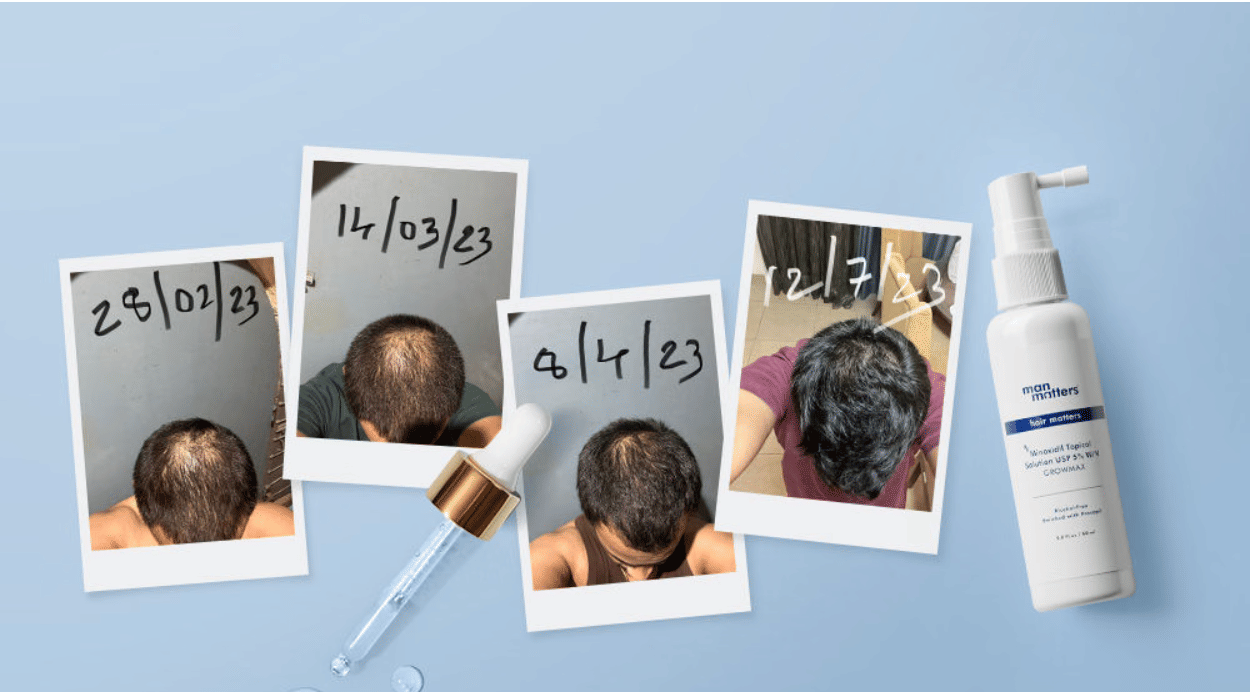
With topical or oral minoxidil, significant improvements in hair density typically occur within 3 to 6 months of daily use with maximum regrowth occurring at around 12 months. Initial shedding in the first 1 to 8 weeks is normal as weak telogen hairs are replaced by thicker anagen growth. Minoxidil activates dormant hair follicles, opens blood vessels to boost the flow of nutrients to the scalp. Continuous application is required to maintain any regrown hair.
What to Expect: Minoxidil Month-by-Month Timeline
Minoxidil hair regrowth takes 12 months to complete 5 stages from shedding to visible follicular density.
Weeks 1-8: The Shedding Phase. Minoxidil forces resting (telogen) hairs out early to allow follicles to re-enter the active growth phase. This shedding can be scary, but to dermatologists it’s a sign the treatment is working, not failing. It usually settles down in eight weeks.
Months 2-3: Early Sub-Surface Growth. The shedding slows down. Fine, unpigmented vellus hairs begin to appear under the scalp. These strands are still invisible to the eye, which is why this phase tends to feel like a plateau.
Months 4-6: Visible Cosmetic Improvements. Terminal hairs are pigmented, thicker versions of vellus hairs. This is when most users see their first real density change at the crown and vertex, which is also why 3 to 6 months is the benchmark most clinicians quote for “visible results.”
Months 6-9: Density Accumulation. Existing strands grow thicker. The mid-scalp is noticeably fuller and photos at month 6 and month 9 typically show a distinct side-by-side difference.
Months 12+: Peak Results and Maintenance. The maximum density is reached in month 12. At this point, minoxidil’s job isn’t to grow coverage, but to maintain the coverage that has regrown. If treatment is stopped at any point, these gains will be lost within an average of about 3 to 6 months as the follicles that responded to minoxidil revert to their dormant pre-treatment state without the ongoing stimulus.
See the Timeline in Photos - Minoxidil Progress by Month
Photo comparisons at months 2, 4, 6, 9, and 12 show the shift from shedding to visible density most users experience.
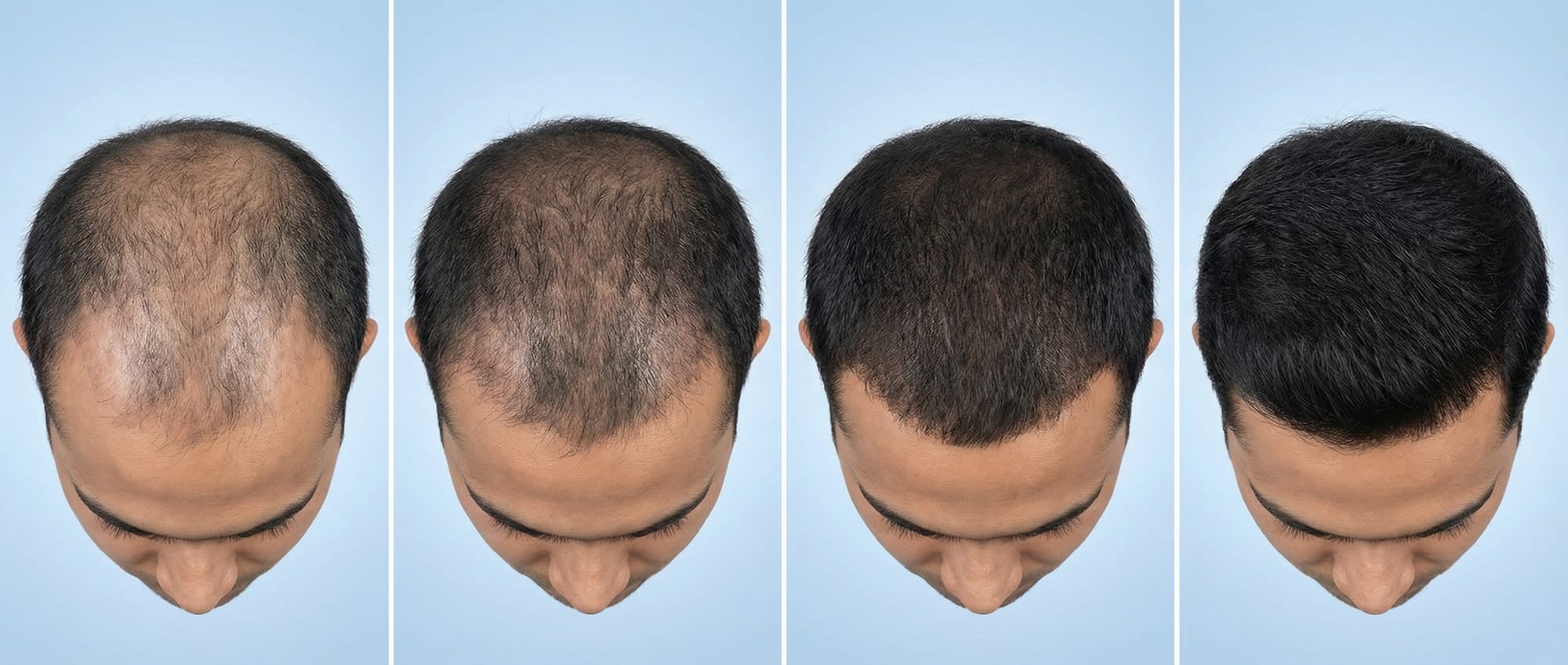
Each pair is worth reading carefully, not skimming. Month 2: Expect scalp visibility to stabilize, don’t expect new growth. At month 4 to 6 check the crown for finer, denser coverage along the part line. Compare hairline thickness at month 9 to 12, not forward advancement because minoxidil rarely pushes the hairline itself forward.
Individual timelines will vary according to age, cause of hair loss and consistency of use. These pictures are a range of general expectations, not a promise of a specific result for any individual.
Minoxidil Before and After: Crown vs. Hairline Regrowth
Minoxidil is clinically most effective at the crown and vertex of the scalp. Hairline improvements are more commonly seen as increased hair density rather than forward line movement.
The crown and vertex respond more rapidly, mainly because the blood vessel network in this region is denser and the follicles tend to remain more viable for a longer period of time, even after the miniaturization process has begun. Minoxidil works better in a well-vascularized area, because of its vasodilating effect.
The front hairline is another story. Minoxidil can also thicken up miniaturized hairs already present just behind the hairline and this appears as increased density upon close examination. On a scalp that is totally smooth and bald it seldom creates new follicles so users expecting the hairline itself to move forward are usually disappointed even if the treatment is otherwise working.
Male and female pattern baldness (androgenetic alopecia) also looks different. In men, the hair line recedes with thinning of the hair on the crown. In women, there is diffuse thinning along the part line with the front hair line often being intact. This is why, over the same 12-month period, female-pattern results at similar minoxidil dosages can look different in before-and-after photos.
Topical vs. Oral Minoxidil: How Results Compare
Oral low-dose minoxidil generally leads to quicker and more even density gains across the scalp than topical 5% preparations, but the two methods tend to balance out to comparable results over time.
The 5% lotion or liquid is applied directly to the scalp, usually twice daily, with the topical application depending on the enzymatic activity of the scalp to convert minoxidil to its active form. Newer cetosomal (nano-vesicle) delivery formulations and Man Matters' Growmax are developed to circumvent this dependence. Clinical scintigraphy studies show that cetosomal minoxidil has significantly better scalp penetration and follicular targeting than traditional hydroalcoholic minoxidil, and that once-daily cetosomal application is better than twice-daily conventional solution and has no detectable systemic absorption. Oral low-dose minoxidil (LDOM) is a single pill taken once a day, and works systemically, so that the scalp does not have to absorb the drug and convert it locally to an enzyme.
A meta-analysis of four randomized controlled trials with 279 patients showed no significant difference in hair density or hair diameter between oral and topical minoxidil. In a 24-week randomized clinical trial in men, oral minoxidil was not superior to topical minoxidil, except for a modest advantage at the vertex on photographic analysis and no meaningful difference at the frontal scalp.
In the real world, it is often compliance, not the drug that makes the difference between outcomes. A once-daily pill is easier to adhere to than a twice-daily topical routine applied to damp, product-free hair, and inconsistent application is one of the most common reasons topical users see disappointing before-and-after comparisons.
Most markets only allow oral minoxidil to be sold with a prescription and it has a much higher rate of unwanted hair growth on other parts of the body (hypertrichosis) than the topical version, as well as potential effects on blood pressure. Switching from topical to oral is a prescription drug so you need to discuss dosage and monitoring with a dermatologist first.
Why Minoxidil Works Better When Combined with Finasteride
Combining minoxidil with finasteride results in a marked enhancement in hair density versus using either of the treatments alone. Minoxidil encourages follicle growth while finasteride inhibits the hormone (DHT) that causes follicle miniaturization initially.
The two drugs attack different parts of the same problem. Minoxidil opens up blood vessels and extends the growth phase of existing follicles. Finasteride is a 5-alpha reductase inhibitor that reduces dihydrotestosterone (DHT) levels and thereby slows the miniaturization process that causes androgenetic alopecia to progress. Using both sides addresses growth stimulation and disease progression at the same time, not only one side of it.
A systematic review and meta-analysis published in 2025 pooled data from seven randomized controlled trials (396 participants) and found that a topical minoxidil-finasteride combination resulted in a clinically significant improvement in hair density, versus minoxidil monotherapy alone. A separate three-arm randomized trial comparing combination therapy to each monotherapy over six months also found the combination statistically superior to either drug alone.
Patients who want to avoid the systemic hormonal side effects often prefer a topical combination spray or gel like Man Matters' Minoxifin to oral finasteride, as a topical formulation concentrates the effect at the scalp rather than throughout the body. A dermatologist can help you figure out the right formula and the amount you need for your particular case.
Why Some People Don't See Results (The SULT1A1 Factor)
Minoxidil must be converted to its active form, minoxidil sulfate, by the sulfotransferase enzyme (SULT1A1) in the root sheath of the hair follicle.
Topical minoxidil works for 30 to 40% of people, in general, and it seems that enzyme activity is one of the main reasons why response can be so variable between two people using the same product the same way. Individuals with low natural SULT1A1 activity convert less minoxidil into its active form, which leads to a blunted response, no matter how consistently the product is applied. SULT1A1 activity at the follicle level has been shown to correlate with response to treatment and has been investigated as a predictive biomarker.
There are a few other secondary factors that can blunt response independent of enzyme activity including iron deficiency, thyroid dysfunction, and scarring forms of alopecia that damage the follicle itself rather than just miniaturizing it. Often, getting minoxidil to work as it should means addressing these underlying issues.
For the non-responders, some clinicians consider adjuvant therapies that boost the enzyme or switch the patients to oral minoxidil, which does not rely on the same topical conversion pathway.
Ready to start your personalized hair regrowth plan? Take our free 1-minute scalp assessment to get doctor-recommended formulas tailored to your stage of hair loss.
How to Track Your Minoxidil Progress Accurately
For accurate minoxidil results, take monthly photos under the same lighting conditions, camera angle and with your hair in the same dry condition.
Five habits make before-and-after comparisons meaningful, not deceptive:
- Every time, take an overhead crown shot, not a mirror selfie.
- Comb hair straight back off face and shoot frontal hairline.
- Use the same bright natural light every time and avoid flash, which can wash out thinning areas or overstate shine.
- Photograph monthly, not weekly. Changes from week to week are too small to read reliably.
- Photograph your dry scalp; thinness and regrowth are hidden under wet or styled hair.
Getting the Most Out of Your Minoxidil Routine
Results are best with twice daily scalp application and realistic expectations of what minoxidil can and cannot reverse. These work better when used directly on the dry scalp, not styled hair. Mild scalp dryness or irritation is common early on – most cases are manageable and settle in the first few weeks, but persistent reddening, burning or flaking is worth mentioning to your doctor.
FAQ Section
How long does it take to see results from minoxidil?
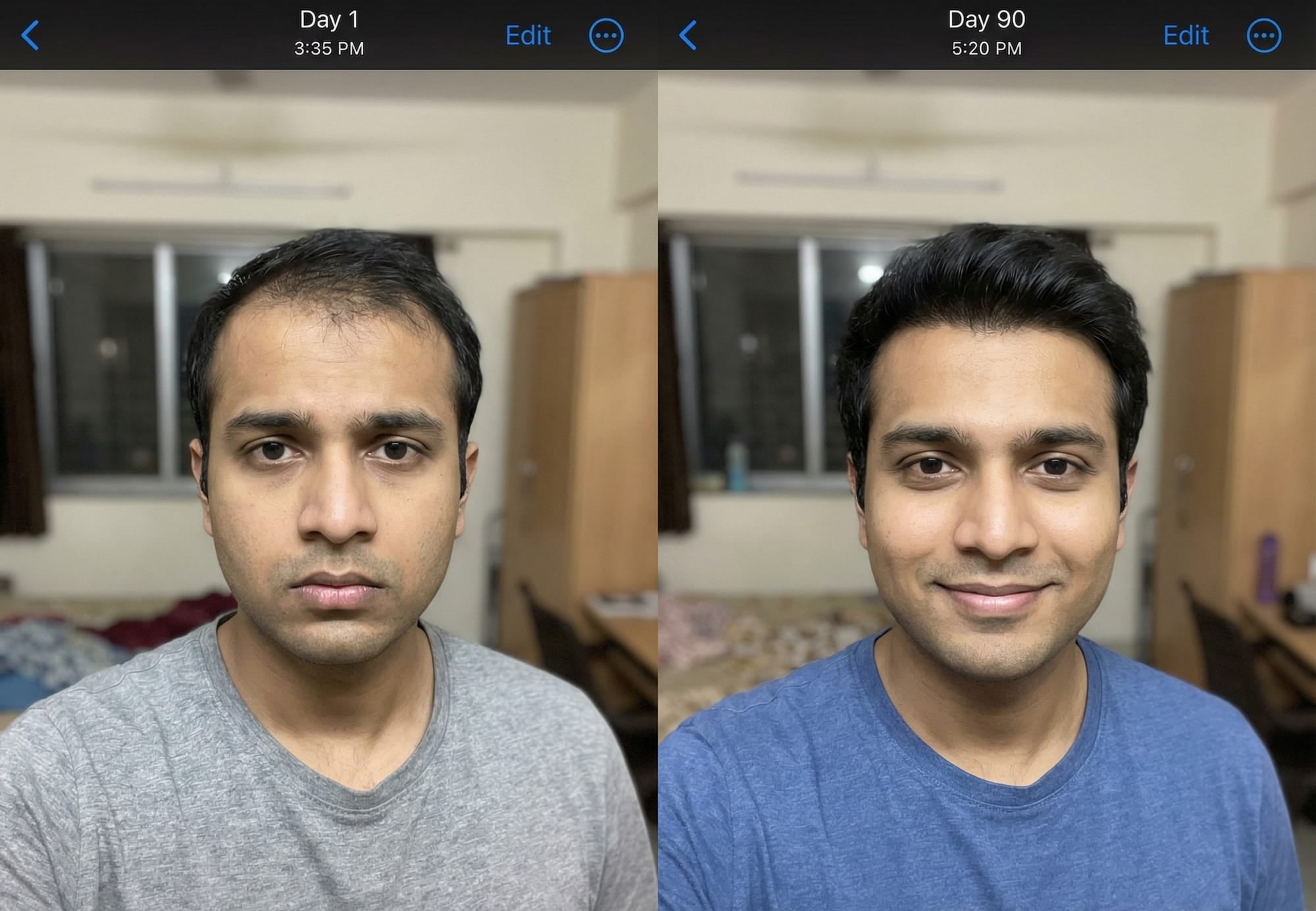
Most people see visible density improvements in 3-6 months of daily use, with peak results around month 12. Normal shedding is normal in the first 1 to 8 weeks. Any regrowth achieved must be maintained with continued daily application.
What happens after 2 years of minoxidil?
Most people stay at the level of density they got to around month 12, and don't see too much more growth after that. Minoxidil effect is more about saving follicles than making new ones. “If you stop at any time, the effects will reverse over 3 to 6 months.
What are the results of 1 year of minoxidil?
You will get the fullest density you will ever get in one year of consistent daily use, especially at the crown and vertex. Changes in the hairline usually involve thickening of existing hair, not new growth forward. Use continuously and results may differ.
Does minoxidil age you faster?
No, minoxidil is a vasodilator that increases blood flow to the hair follicle, and there is no known connection to accelerated skin or biological aging. Some people may feel they appear older during the first shedding phase until new growth becomes visible.