
Does Onion Oil Actually Regrow Hair? A Straight Answer for Men

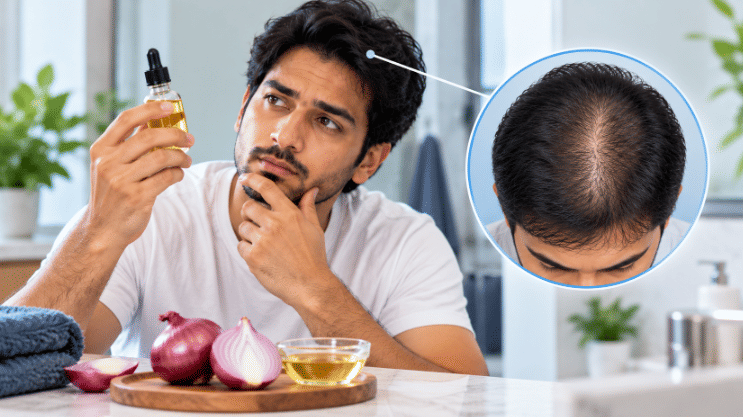
No. There’s not enough clinical evidence to say that onion oil itself encourages hair regrowth. The most cited human study used crude onion juice, not commercial onion oil. It also looked at patchy alopecia areata, not the slow male pattern hair loss that causes most receding hairlines. Onion oil can still be a cosmetic oil for hair care. But softer hair or less breakage does not mean new hair is coming from a follicle. If your hair loss is sudden, patchy or getting worse, a dermatologist should be consulted to find the cause.
Onion Oil and Hair Regrowth: Claim vs Reality
No, the most often cited human study about onions and hair growth does not show that onion oil by itself will regrow hair. Published in 2002, the study applied raw onion juice to exposed areas affected by alopecia areata. It did not test a bottled onion hair oil.
That gap is more important than it looks. One result on one formulation in one condition tells you little about another product used for a different problem.
Most men who search this question do not have alopecia areata. They are watching a hairline recede or a crown thin. Male pattern baldness is the most common type of hair loss in men. It affects around 30 percent of men by age 30 and 50 percent of men by age 50.
Here is where the evidence stands today:
It is right to have the instinct to ask this question before spending money. You deserve a straight answer, including what to do next. Usually, behind this search is a bigger question than onion oil: Is this going to keep happening, and what should I actually do about it? Most men are discovering that without any plan. A plan begins with knowing your type of hair loss, then a dermatologist consultation determines your stage and builds the routine around it.
What Does the Human Onion Study Actually Show?
The cited clinical trial found more regrowth with crude onion juice than tap water in patchy alopecia areata, but did not test commercial onion oil. The trial was published by Sharquie and Al-Obaidi in the Journal of Dermatology in 2002.
Researchers divided 38 patients into two groups. One group had crude onion juice applied to their scalp. The other used tap water. Both groups did this twice a day for two months .
The regrowth was of terminal coarse hairs, the thicker hairs of a normal scalp, not just fine fuzz. The authors also found a higher regrowth in men (93.7%) than women (71.4%) in the onion juice group.
These are impressive numbers. They still require context. Alopecia areata is a disease where the immune system attacks the hair roots, causing patchy, round hair loss. With alopecia areata, you can lose hair, regrow hair, lose hair again, so little short trials are more difficult to interpret.
The trial also has clear limits:
- Small sample: 38 people in total, with only 23 using onion juice.
- One preparation: Fresh crude juice, not an oil, serum or shampoo.
- One condition: Patchy alopecia areata, not pattern hair loss.
- Short window: Two months of treatment, with no long-term follow-up.
- Weak comparison: Tap water, not an established hair-loss treatment.
The fair reading: crude onion juice appeared promising early, condition-specific, in a small trial. Most of the men in the trial didn’t grow hair back with onion oil.
Onion Oil and Onion Juice Are Not the Same Thing
The evidence for crude onion juice cannot be directly translated to commercial onion oil, as the preparation tested was different. The trial used raw onion juice, applied without any additives.
Bottled onion hair oil is another thing. Usually it is a combination of onion extract with a carrier oil, often blended with other botanical oils. How much onion is in each bottle varies from brand to brand and is rarely disclosed on the labels.
Different contents means you can't assume the same effect. A product can have the same name as an ingredient, but not the same evidence.
That doesn’t mean raw onion juice is a good alternative home experiment. India's national body of dermatologists, IADVL, recommends that those with alopecia areata avoid home remedies, which can exacerbate hair loss. It is better to identify the type of hair loss first and then choose the product.
Why Do People Think Onion Oil Can Regrow Hair?
Most claims of onion-oil regrowth are based on proposed mechanisms, traditional use and marketing rather than on direct clinical trials of onion oil. There are four things that keep the belief alive.
The juice study is recycled. Each telling loses a detail. "Onion juice helps patchy alopecia areata" becomes "onion regrows hair" and the condition and preparation are omitted.
That sulfur theory sounds plausible. Onions contain sulfur compounds Hair protein contains sulfur Between the two is marketing. But that link is a hypothesis. It has not been shown to cause follicle regrowth in a trial of onion oil.
Oiling is familiar. Champi is a part of growing up in a number of Indian homes. A good-feeling ritual is easy to trust, even when it can’t change what’s causing hair loss.
Before-and-after posts are deceptive. Hair falls out and grows back in cycles. Most people return to normal fullness in 6 to 9 months after shedding stops, especially after illness or stress. Alopecia areata patches can also grow back without treatment. A photo won't tell you what made the change.
If you’ve lost sleep reading threads on forums about onion oil, you are not alone. Men don't usually talk openly about going bald, so guesswork fills the gaps. It feels like a bottle of oil in the bathroom cabinet, doing something about it without having to tell anyone. A precise diagnosis puts a stop to it.
Does Onion Oil Work for a Receding Hairline or Male Pattern Hair Loss?
Onion oil is not to be marketed as a known treatment for pattern baldness or receding hairline. The cause of pattern hair loss is different from the one in the onion juice trial.
Male pattern hair loss is a genetic and hormonal condition. The body turns testosterone into a hormone known as DHT. DHT affects scalp follicles, and over time, hairs become finer, shorter and lighter. Eventually, those follicles may stop growing hair.
Male pattern baldness is progressive, says IADVL. It doesn’t get better or go away without treatment. Minoxidil and finasteride are commonly prescribed by dermatologists, and can restore hair to a certain degree.
Know your stage to make good choices. The Norwood stages of hair loss are an example of the progression of a receding hairline and thinning crown from early temple recession. An oil cannot tell you what phase you are in or how fast you are moving through it.
Timing is important too. This treatment for male pattern baldness is only effective while you are using it. The sooner you get a plan the more hair you can spare. Our Hairfall Index, based on 7,04,152 consultations, shows how often that window is missed: 87.2% of hair-fall consultations were men under 35, but 65.2% were already at Norwood Stage 3 or higher when they first consulted.
Is There a Better Alternative to Onion Oil for Thinning Hair?
In one practical sense, yes: a formulation that discloses what is in it is easier to judge than an onion oil with an unknown onion content. The Man Matters Advanced Hair Regrowth Serum is made for thinning hair rather than as a general-purpose oil. It lists its lead actives, including 3% Redensyl, 1% Aminexil and 2% Anagain, alongside Procapil, Baicapil and rosemary and moringa extracts. It is a cosmetic serum, not a drug, and the evidence for these actives comes from small studies. Give it 3-6 months of regular use before judging. If your hairline is already receding, a dermatologist can tell you whether minoxidil or finasteride is the right next step.
Can Onion Oil Make Hair Look or Feel Better Without Regrowing It?
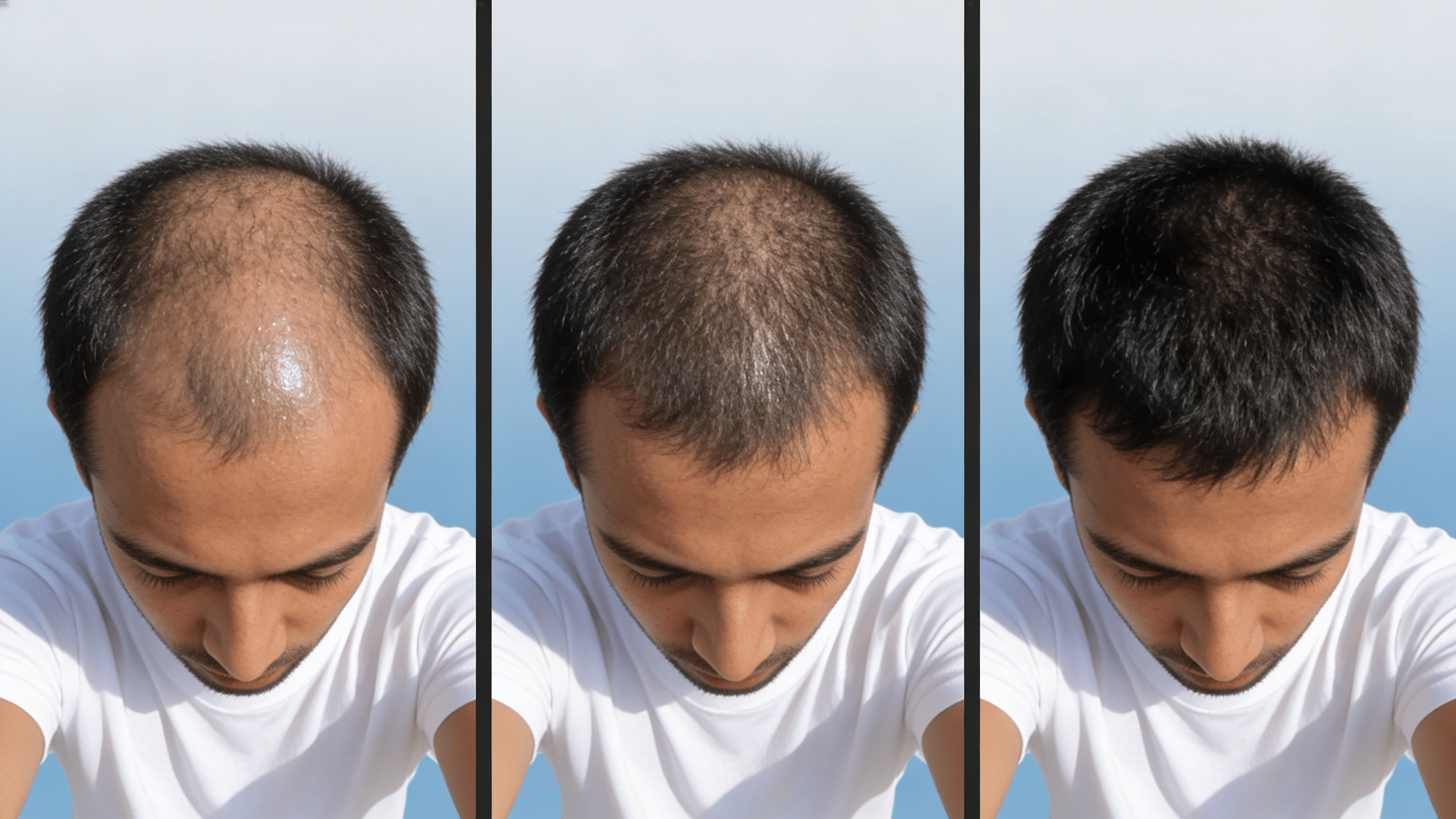
Yes, a hair oil can improve the look and feel of hair, but it won’t cause new hair follicles to grow. The two effects act at different levels of the hair.
Oil is on the hair shaft, which is the part you can see. In its hair-care guidance, IADVL says that after shampooing, a few drops of coconut oil on the hair (not scalp) adds shine. This is a cosmetic effect on the existing strands.
Breakage is a shaft problem too. Overuse of blow dryers and hot irons causes breakage and split ends. Rough towel drying creates frizz and tight hairstyles can cause traction alopecia. Gentler habits fight those causes directly.
Here's the trap. Less hair fall can appear as fewer broken hairs on your comb. Can achieve a smoother look, with thicker looking hair. Neither means a follicle has begun growing a new hair.
So judge onion oil by what it delivers: comfort, texture and shine. Regrowth should be measured by another standard, visible density achieved over months on a diagnosed plan.
If You Still Want to Use Onion Oil, What Is a Sensible Approach?
Onion oil as a cosmetic hair-care step not as a substitute for diagnosis or treatment of the cause of hair loss. Used like that it can sit happily in a routine.
A few ground rules keep it sensible:
- Follow the label. The product's own directions should set how much and how often.
- Massage gently. Aggressive rubbing stresses fragile hair.
- Stop if your scalp reacts. Burning, redness, itching or new flaking means stop and get it checked.
- Skip raw onion experiments. Home-made preparations can irritate the scalp, and IADVL warns that home remedies can make hair loss worse.
- Rinse thoroughly. IADVL’s hair-care basics say, wash the scalp with shampoo and lengths with a conditioner.
Such treatment requires patience. Early shedding can occur between weeks 2 and 8 and at least 6 months of minoxidil is needed to see any benefit. A realistic minoxidil before-and-after timeline shows how change builds month by month.
Most plans don’t fail because the treatment doesn’t work. They fail because they get to week three of the routine. Use reminders and a habit tracker to help you stick with the plan long enough to give it a fair shot.
When Should You Stop Relying on Oils and See a Dermatologist?
If hair loss is sudden, patchy, rapidly worsening, persistent or accompanied by scalp symptoms, consult a dermatologist. The IADVL feels that treatment for hair loss should be effective and should start with identifying the cause.
Make an appointment if you notice:
- Round bald patches or the size of a coin, which IADVL says should be seen by a dermatologist as soon as you notice them
- Clumps of hair coming out
- Redness, itching, flaking or tenderness on the scalp: Scaly, inflamed areas and bald spots can be caused by a scalp infection.
- Balding crown or receding hairline over months
- Hair loss after illness, new medication or stressful period
Your dermatologist will ask you how long you have been losing hair, examine your scalp and may order a blood test if they think there is a deficiency or hormone problem. For many men the visit is worthwhile not for a prescription, but for an answer: what is causing the loss, what stage it has reached and what happens next.
At Man Matters, that journey begins with a free hair assessment. Then you can have a consultation with one of the platform’s verified dermatologists. Your doctor will assess your family history, lifestyle, diet, sleep and photos of your hairline. They figure out what stage you’re at and plan around that. Follow-ups and in-app habit tracking keep that plan progressing.
Hair loss is not a sentence. A schedule, a real time line and a doctor on your side. It's not about a perfect hairline. To be yourself again.
FAQs
Does onion oil really work for hair growth?
Not as a successfully regrown treatment. The single most convincing human evidence for onion is a small 2002 trial of crude onion juice for patchy alopecia areata. Commercial onion oil was not analyzed. This does not prove that onion oil works for general hair loss or male pattern baldness, which are caused by genetics and hormones.
Is onion oil good for hair growth?
Onion oil can also be used as a cosmetic oil for hair care and will add softness and shine to existing hair. Its hair regrowth potential is not proven because the primary human trial used raw onion juice, not the oil. Don’t mistake smoother hair or less broken strands for new hair growing from the follicle.
Which is better, rosemary or onion oil?
Neither rosemary oil nor onion oil can be called a proven universal regrowth oil. Judge any hair oil by the quality of human evidence for your particular type of hair loss, not by its popularity. The medical treatments for male pattern hair loss are Finasteride and Minoxidil.
Which oil regrows hair fast?
No hair oil has been proven to be a quick or universal regrowth treatment. Hair loss has different causes and each requires a different approach. Even prescribed treatment takes time: minoxidil needs at least 6 months to have any benefit. Sudden, patchy or persistent hair loss needs to be assessed by a dermatologist and should not be treated with oil alone.
Does onion juice work better than onion oil?
Onion oil has less direct evidence in humans than onion juice, but only for one condition. In a small trial (2002), patchy alopecia areata was treated with crude onion juice which led to more regrowth vs tap water. But that trial did not test onion oil, so it cannot show that commercial onion oil does the same.