
Minoxidil vs Minoxidil + Finasteride: Which Works Better for Hair Loss?

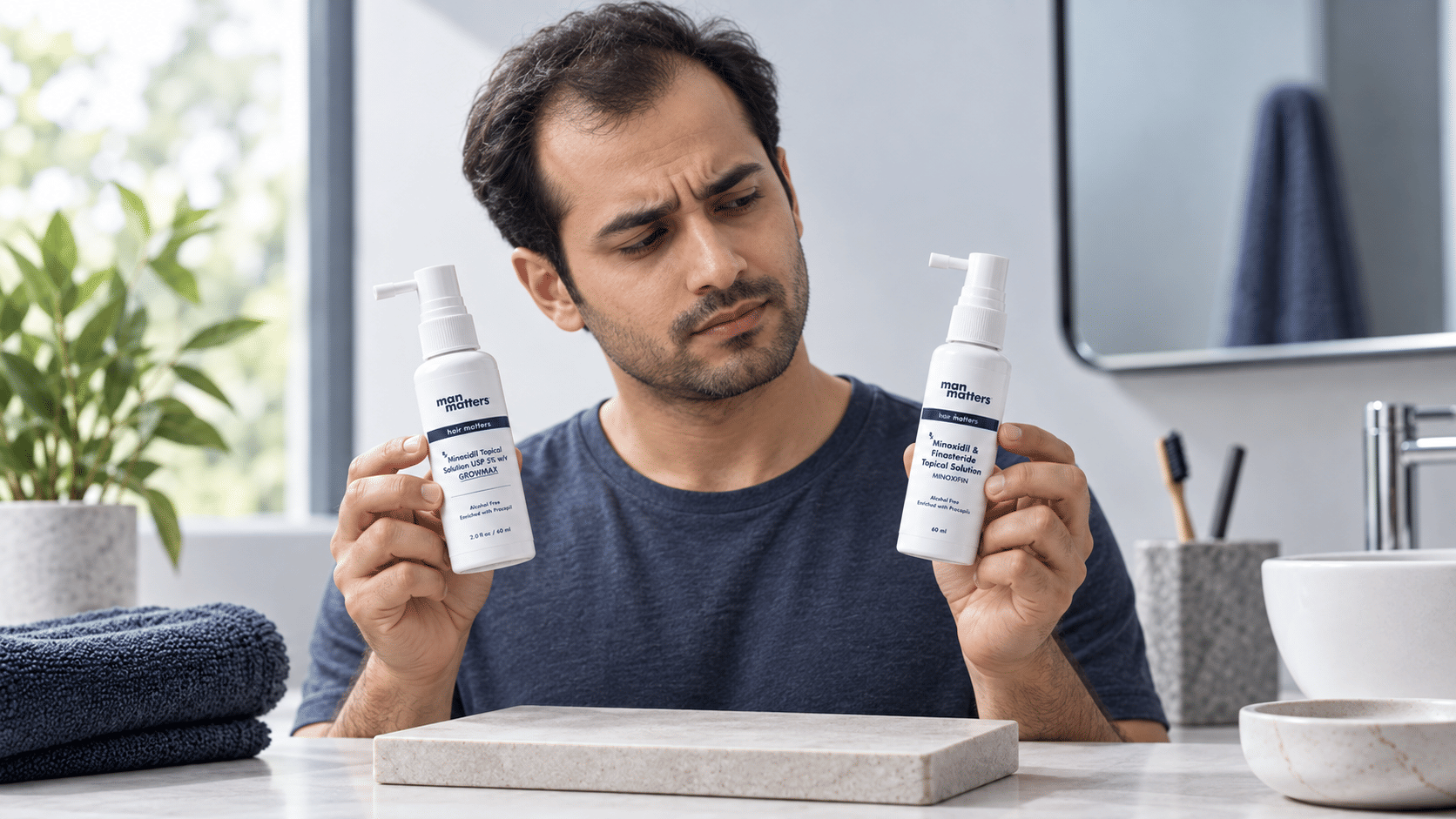
Minoxidil and finasteride work on two different aspects of pattern hair loss, so combining them is targeting two mechanisms instead of doubling up on one. Oral finasteride was marginally superior to 5% topical minoxidil as a monotherapy in men with androgenetic alopecia (AGA) in a 12-month comparison, but the difference between the two was not significant. A 12-month trial showed improvement in 80.5% of men on finasteride, 59% on minoxidil, and 94.1% with combination therapy. Smaller trials of topical combinations also suggest a similar direction, but sample sizes are limited. There is no single "strongest" answer. The right option for you depends on your diagnosis, hormonal profile, and treatment goals.
Minoxidil vs Minoxidil + Finasteride: What Is the Difference?
The mechanisms of action of minoxidil and finasteride are different, so combining the two doesn’t mean one is simply doing the other's job twice over.
What minoxidil does
Minoxidil is a topical vasodilator. It causes vasodilation of the blood vessels around the follicle and prolongs the anagen (active growth) phase of the hair cycle. It does not impact hormone levels.
What finasteride adds
Finasteride works by inhibiting Type II 5-alpha reductase, the enzyme that converts testosterone to DHT (dihydrotestosterone). DHT is the hormone that causes follicle miniaturization in AGA. Finasteride acts on the hormonal trigger, minoxidil acts on blood flow and the follicle cycle.
What combination treatment can mean
A “combination” can be oral finasteride plus topical minoxidil or a topical finasteride/minoxidil formulation. These are not interchangeable. Oral and topical finasteride have different systemic exposure and the evidence for each combination is from separate, smaller trials.
This table reflects study-level results. It isn't a guarantee of the same outcome for every formulation, concentration, or patient.
How Does Minoxidil Work for Pattern Hair Loss?
Minoxidil works by directly widening blood vessels, increasing blood flow to the hair follicles, and extending the anagen phase.
Mechanism and treatment role
More blood flow means more oxygen and nutrients to the follicle. A longer anagen phase means hair stays in its growing stage longer before shedding . This is the reason why minoxidil is often considered to be more of a support to existing follicles than a direct reversal of miniaturization.
Topical formulations and evidence scope
Most monotherapy evidence, including the 5% topical minoxidil arm in a 2015 randomized study, covers standard alcohol- or foam-based topical solutions. If you're deciding between formulations, our guide to which minoxidil is best for hair growth breaks down strength and format differences.
Most of the monotherapy data, including the 5% topical minoxidil arm of a randomized study in 2015, is for alcohol-based or foam-based topical solutions.
How Does Finasteride Work for Pattern Hair Loss?
Finasteride inhibits the enzyme Type II 5-alpha reductase, leading to a decrease in DHT, the hormone that causes follicle miniaturization in androgenetic alopecia.
DHT and 5-alpha-reductase inhibition
DHT binds to receptors in genetically sensitive follicles, causing them to shrink through successive hair cycles. Reducing DHT will not undo damage already done but can slow or stop further miniaturization with ongoing treatment.
Oral vs topical finasteride distinction
Oral and topical finasteride are not pharmacologically equivalent. Oral finasteride enters the bloodstream and decreases DHT everywhere systematically. Topical finasteride is designed to work more locally on the scalp with a lesser, but not zero serum DHT reduction as compared to the oral version. Think of them as two separate products, not two ways of delivering the same exposure.
What Does the Research Say About Minoxidil vs Finasteride?
Head to head trials show that both finasteride and minoxidil produce measurable improvement on their own. The picture across studies is mixed rather than one-sided, some trials give oral finasteride a modest edge, while broader analyses rank topical minoxidil as the stronger topical monotherapy.
Arca et al. 2004: oral finasteride vs 5% topical minoxidil
This open-label, randomized, comparative, 12-month study enrolled 65 men with mild to severe AGA who were treated with oral finasteride or 5% topical minoxidil. For this particular cohort oral finasteride had a slight advantage on hair count but the difference between groups was small - not a wide margin.
Hu et al. 2015: finasteride, minoxidil, and combination therapy
A larger 12-month study randomized 450 patients to finasteride, minoxidil and combination groups, with 428 evaluated at study end. The improvement rates were 80.5% for finasteride, 59% for 5% minoxidil and 94.1% for the combination. Adverse events were uncommon in all 3 groups and resolved with discontinuation of treatment.
Why study design and formulation matter
These figures are derived from specific populations, doses and durations. There were different patient cohorts,12 months vs. 24 weeks, oral vs. topical delivery, none of which generalizes cleanly across products or people. When you see a percentage improvement it is a finding from a particular study, not a universal finding.
Does Combining Minoxidil and Finasteride Work Better?
Yes, mostly. Minoxidil and finasteride work in different ways (blood flow vs hormones), so they usually outperform either one when combined in randomized trials. The catch is the degree to which better depends on the precise formulation and how the study was run.
Evidence for oral finasteride + topical minoxidil
In the Hu et al. 2015 study, at 12 months the combination arm (94.1% improved) was superior to either monotherapy arm.
Evidence for topical finasteride + topical minoxidil
In a randomized, double-blind trial of 40 men over 24 weeks, 0.25% topical finasteride plus 3% minoxidil was compared to 3% minoxidil alone. The mixture resulted in a higher increase in hair density and diameter than minoxidil monotherapy.
Recent topical combination evidence
A pilot trial in 2024 involved 42 men in three arms of topical minoxidil, topical finasteride and the combination with a shorter follow-up window. Trials such as this at pilot-scale help direct future research but have more uncertainty than larger studies.
Limits of combination evidence
There is a caveat to every combination trial above that is - small samples, short duration or formulation specific results. These results cannot be extrapolated to all minoxidil-finasteride products on the market, including those with different concentrations or delivery vehicles.
Minoxidil vs Minoxidil + Finasteride: Side Effects and Safety
Systemic exposure is proportional to systemic hormonal considerations with finasteride, whether taken orally or topically applied, while topical minoxidil poses mainly local scalp risks.
Topical minoxidil effects
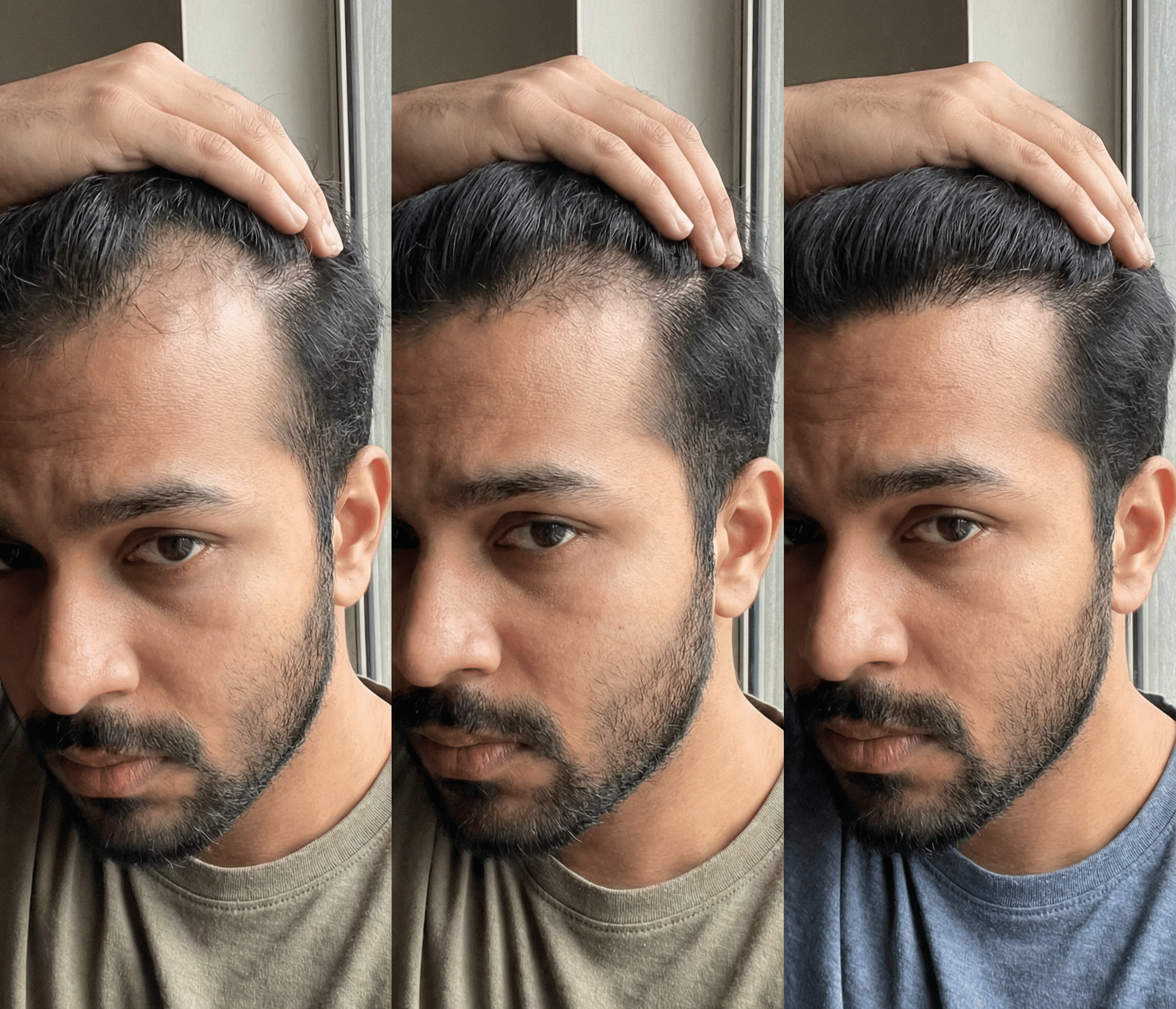
The most common side effects are scalp irritation, dryness and contact dermatitis. Man Matters' Minoxidil and Minoxifin solutions use an alcohol-free formulation, which reduces the chances of these side effects compared to standard alcohol-based minoxidil. If you face any issues, speak to a doctor. A few users also report a temporary increase in shedding during the first few weeks. This is usually described as the hair cycle resetting itself, rather than any sign that the treatment isn't working.
Finasteride-related systemic considerations (oral route)
The prescribing label for oral finasteride contains sexual side effects including decreased libido and erectile dysfunction that have been reported to persist in some men after stopping the medication. Regulators have also added psychiatric warnings to the label over time, including depression and suicidal thoughts or behavior. These are known risks that apply to some users and are not something that is likely to happen, but they are a key reason why finasteride is prescription-only and why you need to have an assessment with a clinician beforehand, including a discussion about your personal or family’s mental health history.
Topical finasteride considerations
Topical finasteride is formulated to reduce systemic exposure relative to the oral form but does not preclude systemic absorption. Less exposure is not no exposure and a topical still needs medical supervision.
When medical review is important
Sudden, patchy, or otherwise atypical hair loss should be evaluated by a clinician rather than self-treated as standard pattern hair loss. Diagnosis precedes treatment selection, not the other way around.
Which Option May Suit Different Situations?
The best treatment depends on diagnosis, extent of hair loss, medical history, and tolerance to hormones, not just on which treatment is the most “powerful.”
When minoxidil alone may be considered
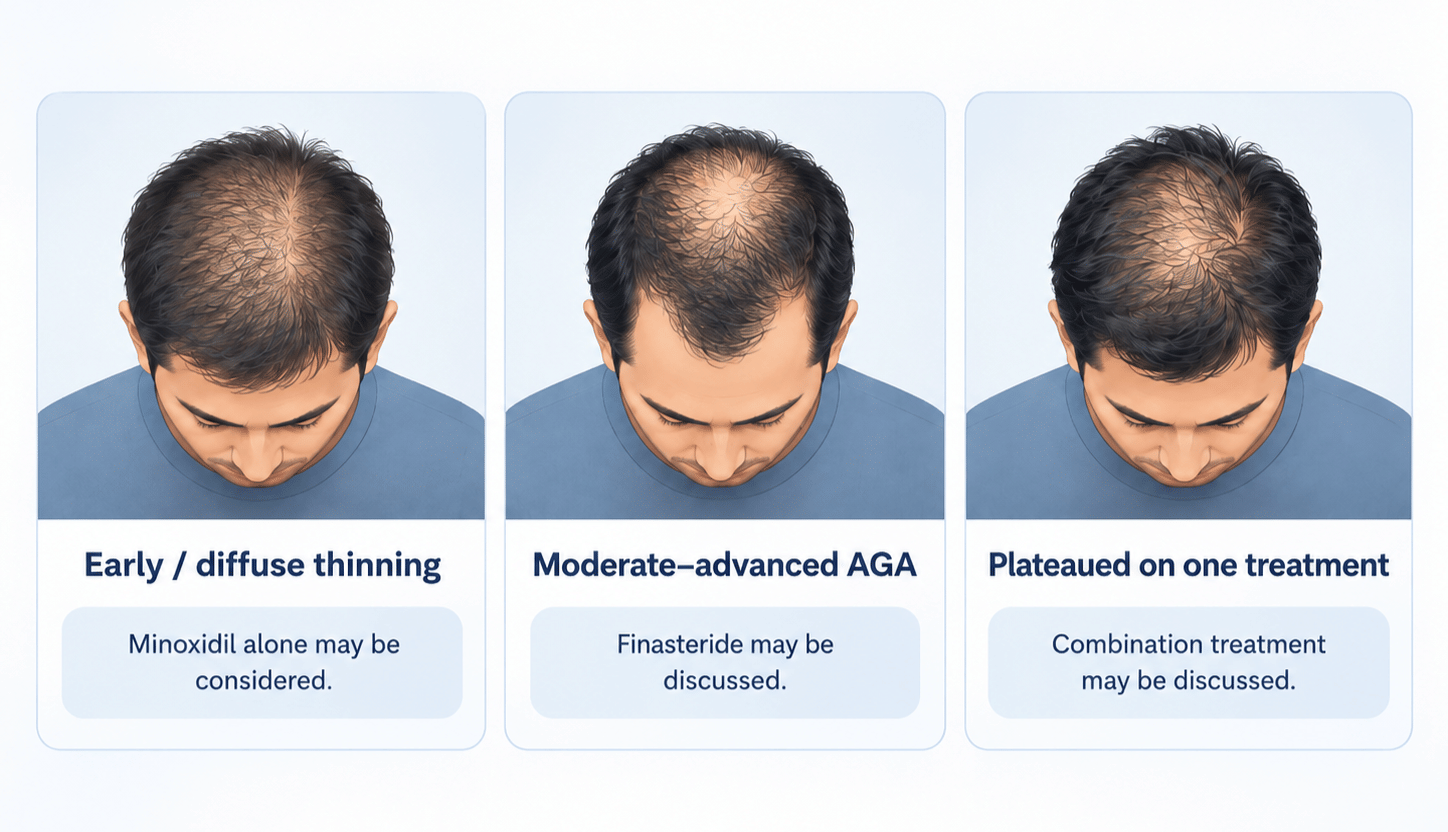
Minoxidil-only regimens are common in candidates with early or diffuse thinning, women (who generally are not candidates for finasteride), and anyone who wishes to avoid hormonal effects.
When finasteride may be considered
Finasteride is usually discussed in the setting of moderate to severe male-pattern hair loss under medical supervision, usually in conjunction with, not in place of, minoxidil.
When combination treatment may be discussed with a clinician
If monotherapy has plateaued, or if a dermatologist feels that the case is one that will likely benefit from a dual mechanism, then combination therapy becomes a point of discussion - not a default starting point.
How Long Do Minoxidil and Finasteride Need to Be Used?
After 3 to 6 months of continued use, most users experience a decrease in shedding. Improvements in fuller density are typically evaluated at 6 to 12 months.
Time to assess response
The Arca and Hu trials used 12-month endpoints; the Suchonwanit trial was assessed at 24 weeks; the Rossi pilot was a shorter course. Just a reminder, “how long until it works” is partly dependent on what study you are comparing against.
What may happen after stopping
Any hair that has grown because of using minoxidil or finasteride will usually be lost when treatment stops. Both are usually given as maintenance therapies, not as one-off cures.
Take our 1-minute Hair Assessment to consult with certified dermatologists and get a personalised plan for your hair loss stage.
FAQs
Is minoxidil useless without finasteride?
No, minoxidil has its own evidence base and can be used effectively independently. Whether to use it alone or in combination with finasteride depends on your diagnosis, stage of hair loss, and treatment goals, best assessed with a clinician.
Does finasteride stop balding?
Finasteride can slow the progression of androgenetic alopecia or reduce the progression as long as treatment is continued, but it does not guarantee a certain result for any individual and the effects are not permanent after discontinuation.
Is minoxidil + finasteride more effective than minoxidil alone?
Combination treatment has resulted in greater improvements in hair density than minoxidil alone in many clinical studies, as the two work by different mechanisms – increased blood flow versus reduced DHT. Results may differ based on formulation and individual.
Can women use minoxidil + finasteride?
Finasteride is not recommended for women unless it is prescribed by a dermatologist because it affects androgen hormones and carries risks during pregnancy or childbearing years. Minoxidil is the main topical therapy used by most women alone.
Is 25 too late to start finasteride?
Age by itself is not a determining factor for finasteride. It is better to discuss with a clinician rather than to decide based on age. It is contingent upon the diagnosis, severity of hair loss, medical history and individual risk factors.
Is minoxidil or finasteride safer?
Minoxidil and finasteride work differently and have different risk profiles. Minoxidil risks are mostly local (scalp irritation), while finasteride risks are hormonal. Neither is universally “safer.” The better choice depends on your health profile.